Last reviewed: October 5, 2026
If products arrive damaged from China, record the delivery condition, separate affected stock, and keep the goods and all packaging. Notify the supplier, shipping provider, and any cargo insurer promptly in writing. Match the damage to specific cartons and quantities, check the sales and freight contracts, and request claim instructions. Agree on a documented remedy after reviewing the cause and recovery cost. Contacting your supplier alone may leave a carrier or insurer’s reporting deadline unmet.
Key takeaways
- Record visible damage at delivery and inspect the contents promptly. Keep carton numbers linked to the damaged units.
- Notify the relevant parties while you investigate. A supplier conversation does not replace a formal transport or insurance claim.
- Check the agreed delivery term, packing requirements, freight contract, and insurance documents before deciding who should pay.
- Price the complete remedy, including replacement freight and handling. A free replacement can still leave the buyer with a substantial cost.
This guide covers commercial orders received from Chinese suppliers, including purchases from 1688.com. It focuses on arrival damage. For checks while the goods are still in China, use the bulk order inspection guide.
What should you do as soon as damage is discovered?
Record what the receiving team can actually see
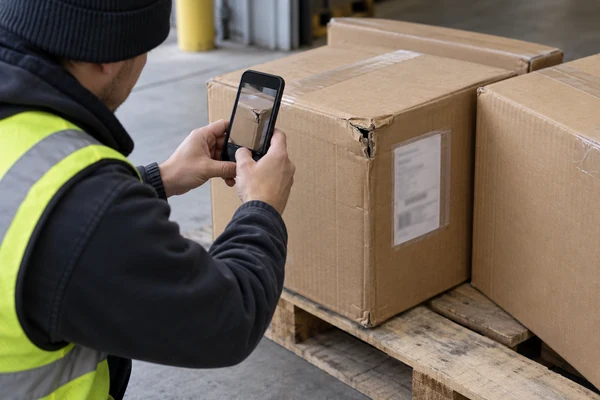
Before removing wrapping or moving cartons into storage, photograph the shipment as received. Capture the pallet or carton group, shipping labels, and the affected area. Record crushed corners, wet cartons, broken seals, holes, or missing pieces on the delivery record where the delivery process allows it. Keep a copy.
Write what you see: “cartons 7 and 8 have wet lower panels”. A note saying “damaged” gives the claims reviewer little to work with. If the driver has already left, record when the goods arrived and when the damage was discovered, then send written notice immediately.
DHL Global Forwarding’s claim guidance for Greece advises recording visible damage on transport documents and retaining the goods and packing materials. Confirm the procedure for your own booking.
Keep affected stock identifiable
Label the cartons and separate affected goods from stock cleared for sale. Record the SKU, quantity examined, quantity damaged, and quantity still unchecked. If damage is discovered in one carton, inspect enough other cartons to understand its distribution; keep a suspect batch on hold while that scope is being checked.
If the first opened carton contains 12 broken units, report 12 confirmed units and list the cartons still unchecked. Update the count as the receiving team examines them. This keeps the supplier and claim handler working from the same information.
Keep the condition intact for inspection. Before repair, disposal, return, or onward transport, request written instructions from the claim handler. Document any urgent action needed to prevent further damage.
How can you distinguish shipping damage from a product defect?
Arrival damage tells you when the problem was found. It does not establish when it happened. Compare delivery photographs with the inspection report, packing records, and condition at each recorded handover.
| Observed pattern | Possible explanation | Evidence to compare |
|---|---|---|
| Cracked items beside a crushed carton panel | External impact, compression, or inadequate protection | Damage position, carton condition, internal supports, and dispatch photographs |
| Scratches where units touch inside an intact carton | Movement in transit or insufficient separation between units | Actual packout, approved separators, empty space, and the packing specification |
| The same weak joint fails across different cartons | A production weakness, unsuitable packaging, or a combination | Failure location, sample construction, batch records, and technical examination |
| Wet cartons, stains, or corrosion | Water exposure, condensation, or moisture already present before dispatch | Condition at handovers, storage records, moisture protection, and survey findings |
These are investigation leads. A crushed box alone cannot identify the responsible handler, and an intact box cannot rule out transport damage.
Ask whether the China warehouse repacked the order, changed the inserts, or combined products with different weights. If several suppliers contributed goods, preserve each supplier’s carton and SKU references. Mixing them during unpacking can make the later discussion much harder.
A pre-shipment inspection report helps establish what was checked at origin. Read its scope and sample size before using it to argue that every shipped unit was sound.
Who should you contact: the supplier, forwarder, carrier, or insurer?
Contact the supplier about the product and packing requirements. Contact the shipping provider about the delivery condition and transport claim. If you have cargo insurance, also notify the insurer or broker through the policy’s reporting channel.
Ask the shipping provider to identify the party that booked the transport, the carrier handling the affected leg, and who can submit the claim. A forwarder may coordinate the process without being the carrier that performed every movement.
UPS’s U.S. claim guidance allows some recipients to start claims, but account restrictions can require the shipper’s involvement. Ask who will file, who will receive correspondence, and how any payment will reach the party bearing the loss.
Check the sales terms separately from the freight booking
Find the agreed Incoterms rule, named place, and edition in the purchase documents. Then check the freight contract and any separate warehouse or repacking agreement. Those documents answer different questions.
The International Chamber of Commerce’s guidance on Incoterms and commercial contracts explains that the rules allocate delivery obligations, risk, and certain costs. They do not specify the goods or provide the remedies for a breach of the sales contract. Risk transfer and a supplier’s failure to meet an agreed packing requirement therefore need separate review.
Read the risk-transfer point even if the supplier paid the international freight. Under CIP Incoterms 2020, for example, the seller arranges carriage and insurance to the named destination, while risk generally transfers when the goods are handed to the contracted carrier at the delivery point. See ICC Academy’s explanation of CPT and CIP.
If a quotation only says “door-to-door”, ask for the actual sales and freight terms. That service description leaves too much unresolved for a damage dispute.
What evidence should go into a damage claim?

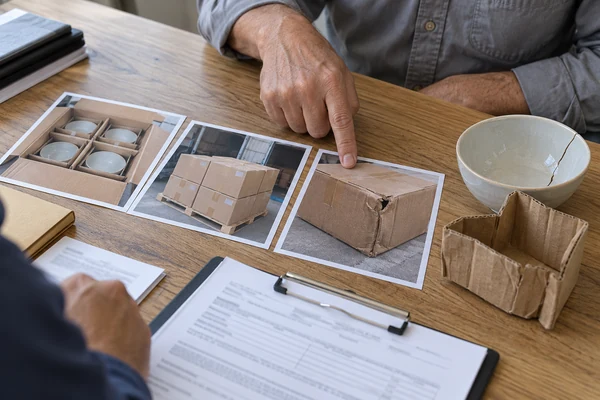
Create one case folder with the order and shipment reference. Preserve original photo and video files. Name evidence by carton and unit so the reviewer can connect a close-up of a crack with the box that contained it.
| Record | What to include | Question it helps answer |
|---|---|---|
| Shipment identity | Tracking or transport reference, delivery record, arrival date, carton numbers | Which shipment and pieces are affected? |
| Receiving condition | Whole shipment, labels, seals, wrapping, and close-ups of visible damage | What condition was recorded at arrival? |
| Product and packout | Damaged unit, its position in the carton, cushioning, separators, and nearby units | How does the damage relate to the packaging? |
| Quantity reconciliation | SKU, cartons checked, units checked, confirmed damage, unchecked stock | How much of the order is affected? |
| Value and recovery cost | Purchase invoice, unit cost, repair estimate, replacement and freight quotations | What loss and proposed remedy can be documented? |
| Origin and contractual records | Inspection report, packing specification, dispatch photos, sales and freight terms, policy certificate if insured | What was agreed and recorded before transport? |
Ask the handler whether a survey or physical inspection is needed before changing the goods’ condition. For a disputed cause or substantial loss, an independent examination may be worth arranging; agree on access and scope first.
Record both product damage and packaging damage. Ten intact products in unusable branded retail boxes create a different recovery problem from ten broken products. A missing accessory belongs on its own line as well.
How soon must you report damaged goods?
Send initial written notice as soon as the damage is discovered, even while the count is incomplete. Ask for the relevant deadline, the event that starts it, the required recipient, and confirmation that your notice has been registered.
Check notice, supporting-document, and formal claim requirements separately. A customer-service ticket may not complete them all. Use the terms that apply to the booked service and route.
For example, FedEx’s U.S. parcel and air-freight claim page states a 21-calendar-day limit from the shipment date for damage or missing contents on international packages. Its listed U.S. package limit is 60 calendar days from shipment. UPS’s U.S. page says to start a damage claim within 60 days of scheduled delivery and notes that timeframes vary by country.
The difference matters: shipment date and delivery date can be weeks apart. These examples are not a deadline calculator for every China shipment. Verify the applicable transport terms and insurance policy immediately.
How should you ask the supplier and shipping provider to respond?
Send a short factual notice with the records already available. State which quantities are confirmed and which remain provisional. Request a case number and the next required action.
Order [PO number], shipment [reference], was received on 2026. We found [damage description] in cartons [numbers]. We have checked [quantity] units and confirmed [quantity] affected units so far; the remaining suspect cartons are on hold. Attached are the delivery record, photographs, and initial count.
Please confirm the claim contact, filing requirements and deadlines, and whether the goods must remain available for a survey. Please also provide the relevant dispatch, packing, and handover records. We will update the count after inspection.
With the supplier, add the approved packaging revision and ask for the actual packout used. With the forwarder, ask for receiving, repacking, dispatch, and destination handling records relevant to the damaged cartons.
A reply saying “we will fix it on the next order” needs a measurable agreement. Record the number of replacements or credit amount, due date, freight allocation, and whether it is conditional on another purchase. Keep any carrier or insurance claim active according to its requirements while a supplier remedy is being discussed.
Should you request a refund, replacement, repair, or credit?
Compare the options on what it will take to restore saleable stock. The product’s unit price is only one line. Include local sorting, repair or repacking, replacement freight, and any import charges confirmed by your broker.
| Option | When to consider it | What to agree in writing |
|---|---|---|
| Replacement units | The product cannot be restored economically and replacement timing works | Quantity, specification, improved packing, dispatch date, freight, and destination charges |
| Local repair or repacking | A defined correction can restore the goods to the required condition | Method, inspection, cost approval, and claim-handler permission before work begins |
| Refund or cash settlement | Replacements arrive too late or continued purchasing is unsuitable | Amount, currency, payment date, affected stock, and any rights released by settlement |
| Credit against a later order | You already intend to reorder and can accept delayed recovery | Credit amount, expiry, minimum-purchase conditions, and how it appears on the next invoice |
For a hypothetical order, 40 damaged units at US$6.50 each represent US$260 in product cost. If a replacement shipment adds US$95 in freight and US$60 in handling, replacement also requires US$155 in logistics. Confirm who pays those costs before accepting “free replacement”.
Keep business impact, such as missed sales, separate from documented physical loss. Whether it can be recovered depends on the contract or policy. Record payments or credits already received so overlapping claims do not seek recovery for the same loss twice.
What if the claim is rejected or responsibility is disputed?
Ask for the written reason and the exact contractual or policy provision used. A rejection for missing documents needs a different response from a finding of inadequate packing or a missed reporting deadline.
Check whether the decision used the correct shipment, damage count, and evidence. Submit material records that were omitted, then ask for the review procedure and its time limit. If the dispute concerns the product or packing contract, keep that discussion separate from the transport claim.
For a significant unresolved loss, a cargo surveyor or a lawyer familiar with the relevant contracts can assess the evidence and next step. Compare the likely recovery with the cost of pursuing it. Keep the case number, correspondence, and originals accessible.
What should change before the replacement leaves China?

Ask for a correction tied to the observed failure. If units rubbed together, check separators and movement inside the carton. If a carton collapsed, review its load, structure, and stacking arrangement. Request a sample of the revised packout and a transport test appropriate to the product and route when needed.
Check what changed behind the photograph of the new box: its materials, dimensions, product orientation, and packed weight. Our guide to choosing a product supplier or separate packaging factory explains how to assign packaging work and approve fit.
Recheck the insurance arrangement as well. Obtain the insurer’s name, policy or certificate, insured shipment, value, deductible, exclusions, and reporting instructions. FedEx explains that declared value increases its liability limit and is not shipping insurance. Neither an invoice value nor a freight quote saying “insurance included” describes the complete protection.
Dawon1688 can help coordinate supplier communication, agreed receiving checks in China, repacking, and replacement shipment quotations within the service scope. If the original order was handled elsewhere, the records available and the supplier’s cooperation affect what can be checked. Send the order reference, damage evidence, quantity breakdown, and proposed remedy through the Dawon1688 contact page.
Before dispatch, use the 1688 shipping guide to confirm the revised route, packed dimensions, freight scope, and claim contacts.
Arrival-damage response checklist
- Record delivery condition and carton references.
- Hold suspect stock and reconcile the inspected and affected quantities.
- Preserve goods, packaging, and original evidence files.
- Send written notice through the relevant supplier, transport, and insurance channels.
- Confirm deadlines and whether a survey is required.
- Compare the sales terms with freight, repacking, and insurance documents.
- Calculate the full cost of each remedy and document the agreement.
- Verify the revised product and packaging before replacement dispatch.
When products arrive damaged from China, preserve evidence and reporting options first. Use the records and contracts to investigate responsibility, then agree on a remedy that restores usable stock at a known cost.
Official sources and scope
Reviewed on October 5, 2026. Carrier pages below cover the stated market or service; your booking and policy determine the applicable procedure.
- UPS U.S.: filing a claim, for packaging retention, claimant restrictions, and the published U.S. deadline.
- FedEx U.S.: parcel and air-freight claims, for the international-package damage deadline and reporting process.
- DHL Global Forwarding Greece: preparing a claim, for delivery records and preserving goods for investigation.
- ICC: Incoterms and commercial contracts and ICC Academy: CPT and CIP, for the distinction between freight arrangements, risk transfer, and sales remedies.
- FedEx: declared value, for the distinction between a carrier liability limit and insurance.
Frequently asked questions
1. Can I report hidden damage after signing a clean delivery receipt?
Report it immediately through the applicable claim channel. Record when and how it was discovered, retain the packaging, and provide the delivery and unpacking evidence. A clean receipt can complicate proof of where damage occurred; it does not provide a universal answer about claim eligibility. The service terms, reporting deadline, and evidence control the review.
2. Is an unboxing video required for a shipping damage claim?
Requirements vary by claim process. A continuous video can help link the unopened carton to the damaged contents, but it does not replace the shipping label, invoice, damage count, or any requested inspection. If you did not film unpacking, preserve the photographs and records you have and ask the handler what additional evidence is needed.
3. Should I reject the whole delivery if only one carton looks damaged?
Record the affected carton and ask the delivery provider for its procedure before deciding. Refusal can trigger return, storage, or other charges and may separate you from evidence. Partial acceptance may be available, but depends on the booking. Where practical, contact the booking party while the delivery is still present and document the instruction.
4. Can I claim a loss when the products are intact but branded retail boxes are damaged?
Document the damaged boxes separately and obtain a repacking or replacement-packaging estimate. Explain whether the packaging is part of the purchased sellable unit and why its condition affects saleability. Coverage or supplier recovery depends on the relevant terms. Intact products do not establish that a packaging loss is covered, and damaged boxes do not justify claiming every enclosed product as destroyed.
5. Can I replace the packaging or repair the goods before the claim is decided?
Request written instructions first because the handler may need to inspect the original condition. Provide photographs, the proposed correction, and its cost. If action is needed to prevent further damage, record the reason and preserve evidence of what changed. Keep replaced parts and packing materials when the handler requires them.
6. How should I document damage in a consolidated shipment from several suppliers?
Map each affected carton to its supplier, purchase order, SKU, and original packing record. Identify whether the consolidation warehouse opened or repacked it. Record the shared shipment reference as well as the carton-level loss. Report the transport incident through the appropriate booking channel and discuss each supplier’s product or packaging issue using its own records.
7. Should I pay for replacement stock while the original damage claim is still open?
Price that decision against the cost of waiting for stock. Keep the replacement purchase separate from the claim and record any supplier credit or later reimbursement. Confirm whether a proposed settlement releases other claims before accepting it. A new purchase does not establish that the original loss will be reimbursed, so plan for the cash needed until recovery is confirmed.