Order selected spare parts with your first bulk order from China when you can identify the correct components, confirm compatibility with the production version, and use them safely to solve a realistic customer problem. Do not accept a generic percentage of “free spares” as a complete after-sales plan. For some products, ordering parts later or keeping complete replacement units makes more sense.
Before approving the order, ask the supplier for a component list, a method of identifying compatible versions, and separate terms for replenishment. You need to be able to identify and supply a usable replacement when a customer asks for one.
Start with the customer problem a spare part can solve
A missing removable foot, a lost knob and a damaged main housing are different support problems. A small component may restore a product to use, but only if the replacement is suitable and the recipient can fit it correctly. Some products are sealed, require specialist servicing, or are uneconomical to repair.
List the components that can be replaced under the product supplier’s instructions. For each, record what problem it addresses and who is allowed to replace it. Keep electrical, battery, load-bearing and other safety-critical work out of a casual customer self-repair plan. Obtain product-specific advice from the manufacturer or an appropriately qualified service provider.
Parts availability alone does not establish that a product is safe to repair. Confirm product-specific requirements in the destination market before offering a repair route.
Ask for an orderable parts list, not a bag of extras
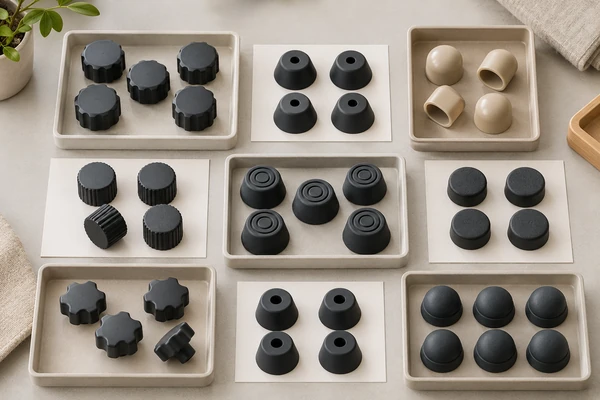
Give each part a reference that both buyer and supplier recognize. Use a component code, an annotated drawing or a clear photograph tied to the approved product revision. A description such as “small black clip” is inadequate when the supplier has several similar versions.
IKEA’s spare-parts guidance, for example, directs customers to the unique assembly-part number in the instructions. That is an identification practice, not evidence that a Chinese supplier offers the same service or terms.
| Record | What to confirm |
|---|---|
| Finished product | Buyer SKU, supplier model, approved revision and relevant batch |
| Component identity | Part code, description, photograph or drawing, material and finish where relevant |
| Compatibility | Exactly which product revisions accept this part, including any restrictions |
| Replacement scope | Supplier instructions and whether the customer or a qualified technician can fit it |
| Initial supply | Quantity by part code, price or agreed inclusion, packaging and delivery with the main order |
| Replenishment | Later MOQ, quoted lead time, price basis and who confirms availability |
| Change control | Notice of revision or discontinuation and the process for approving an alternative |
Keep this record alongside your approved sample specification. A parts sample should be checked against the version that will actually ship, rather than an earlier development sample.
Confirm compatibility before discussing quantity
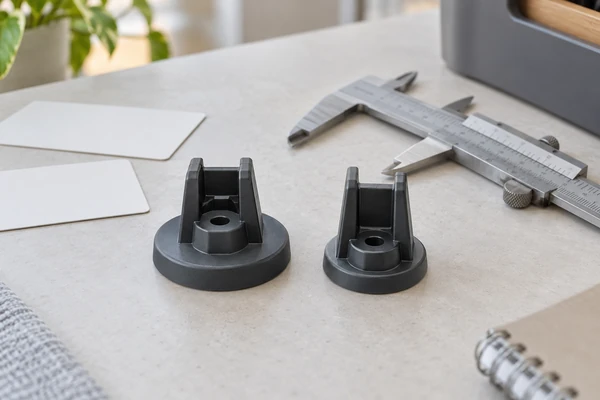
A familiar product name does not prove that its parts are interchangeable. Ask whether a component changed between the sample, the production batch and any later order. Relevant differences may include attachment geometry, dimensions, material, finish or a matching component that also changed.
For example, IKEA says its older and newer VIDGA ceiling brackets cannot be combined following a design update. Other revisions may remain compatible; ask the supplier to confirm each change.
Use a compatibility record that survives a repeat order
Record the finished-product revision next to each approved part. Keep a reference sample when practical, and obtain written confirmation of any replacement or superseding code. Do not relabel an alternative as interchangeable until the relevant fit, function and safety requirements have been checked by the responsible party.
If the supplier cannot distinguish the versions, treat compatibility as unresolved. Resolve that question before buying a large spare-parts quantity. The broader risks of changes between production batches are covered in our repeat-order quality guide.
Choose a support route for each component
| Approach | When it may fit | Main trade-off to check |
|---|---|---|
| Stock selected parts with the first order | Compatible, usable parts are small enough to hold and waiting for a later shipment would undermine the support plan | Cash tied up, storage conditions and obsolete stock after a revision |
| Order parts when needed | The supplier can confirm replenishment and the buyer can tolerate the full response time | Availability, MOQ, separate freight and delivery uncertainty |
| Hold complete replacement units | Component replacement is impractical or the likely support problem cannot be isolated reliably | Higher inventory cost, space and a plan for the returned unit |
| Arrange qualified repair support | The product needs specialist diagnosis or approved repair work | Provider availability, instructions, parts access and the actual service scope |
These approaches can be combined. A buyer might hold simple removable fittings, obtain uncommon cosmetic parts later, and use a qualified service provider for technical faults. Check whether the proposed arrangement suits the product and the buyer’s customer commitments.
How many spares should you buy without a sales history?

There is no reliable universal percentage for a first order. A supplier’s allowance may be a commercial offer, not an estimate of your future parts demand. Ask what evidence supports the proposed quantity and whether it refers to each component or to all spare pieces combined.
Oracle’s service-parts planning guide treats service-parts demand separately from finished-product inventory and discusses usage history, the population of products in service and replacement-part revisions. For a small importer, a worksheet can track the same basic information.
For a new product, write down the uncertainty instead of presenting a guessed failure rate as fact. Consider the number of units you expect to put into use before replenishment could arrive, any relevant pilot or supplier evidence, the consequences of a missing part, and the cost of holding stock that may not be used. Ask for the assumptions behind supplier figures and whether they relate to the same product revision and use conditions.
Compare the complete replenishment cost
Compare adding selected parts to the first shipment with ordering them separately later. Include part price, supplier minimum quantities, packing, handling, freight and the expected support delay. For route and shipment decisions, use the 1688 shipping guide; obtain a current quotation rather than assuming a small component will be cheap to send internationally.
Have the buyer approve the quantity and its rationale before ordering. Review actual consumption, unresolved requests and remaining compatible stock after sales begin.
Separate the supplier’s remedy from your stock plan
A supplier may agree to review a fault report or provide a replacement with a future order. That does not tell you how a customer will receive a usable part now. Agree separately on the evidence required for a claim, who makes the decision, what costs each party has accepted and how approved replacements will be dispatched.
Ask what happens if you do not place another bulk order. Can the part be purchased independently? Is its minimum order different from the finished product’s MOQ? Can the supplier still identify and supply the earlier revision? Record confirmed terms rather than relying on “we will help later.”
Commercial terms vary by order. This article does not promise free parts, refunds, a warranty duration or a particular remedy, and it does not replace advice on your obligations to customers.
Pack and identify spares separately
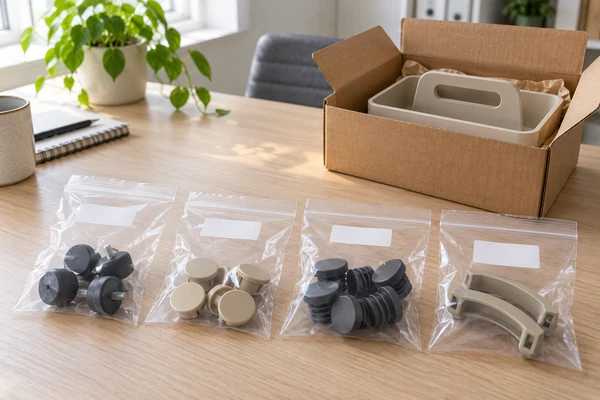
Specify packaging by component code and compatible product revision. Keep different versions separate, label the outside of the bag or box and include the agreed quantity on the packing information. Avoid loose mixed fittings that have to be identified again after arrival.
Agree how receiving checks will verify the part identity and quantity, and what remains unchecked. A bag count is not the same as a count of individual parts. Keep service stock separate from components needed to make each finished unit complete; the same piece cannot fill both roles in the inventory record.
A simple example: removable clips for a storage organizer
This is a hypothetical planning example, not a Dawon customer case. A buyer orders an organizer with removable clips. The supplier offers a mixed bag of extras but has not identified which clips fit the approved version.
The buyer first requests a part code and a photograph linked to the production revision, confirms the supplier’s replacement instructions and arranges an appropriate compatibility check. The buyer then asks for a separate quote for an initial quantity and for replenishment without another organizer order.
If a later organizer revision uses a different clip, the two stocks remain separate until compatibility is confirmed. The buyer records which revision each customer received before selecting a replacement. The buyer can establish these records even before there is enough sales history to estimate demand.
What to send Dawon1688 before requesting coordination
Dawon1688’s published service scope includes supplier communication, samples, purchasing, inspection coordination, packaging and shipping coordination according to the order. Send the product link, approved revision, proposed parts list, destination and the questions the supplier still needs to answer through the contact page.
Ask which sourcing, sample, identification and packing checks can be coordinated and request a quotation for that scope. Do not assume Dawon manufactures the parts, performs repairs or guarantees a supplier’s future stock. The buyer should approve the compatible parts, quantities, costs and support arrangement before purchase.
Frequently asked questions
1. Should every first bulk order include spare parts?
No. Include selected parts when they can solve a realistic support problem, match the supplied product revision and be replaced safely under the appropriate instructions. For other products, ordering parts later, holding replacement units or arranging qualified service may be more suitable.
2. Is a fixed percentage of free spares enough?
Not by itself. Confirm the actual part codes, quantity of each component, compatibility and delivery terms. An allowance does not establish expected demand, and a mixed bag of unidentified parts may not help when a particular replacement is needed.
3. What should I request to identify the right component?
Request a supplier-recognized part code, a clear photograph or drawing, and a link to the finished-product model and revision. Record relevant material, dimensions or finish requirements and the versions with which the supplier confirms compatibility.
4. Can a new version replace an older spare part?
Only after compatibility is confirmed. A revised part may require a different matching component or may not fit the earlier product. Keep the original and proposed replacement references separate until the responsible party approves the relevant checks.
5. How should I choose an initial quantity without sales data?
Document the assumptions behind the quantity, including expected units in use before replenishment, available evidence, replenishment time and the consequences of running out. Compare holding costs with later ordering costs. Do not present a guessed failure rate as measured data.
6. Should spares be packed with finished products?
They can travel in the same shipment if appropriate, but identify and pack service stock separately by part code and compatible revision. Record quantities clearly and do not count components needed to complete the finished products as spare inventory.
7. Does a supplier’s replacement promise cover immediate customer support?
Not necessarily. Confirm the evidence required, decision process, charges and dispatch arrangement. A replacement offered with a future bulk order may not meet a current support need. Keep the supplier’s commercial remedy separate from your customer-support stock plan.
8. Can Dawon1688 help arrange a spare-parts order?
Ask Dawon1688 to confirm the available supplier communication, sampling, purchasing and packing coordination for your product. Provide the approved revision and parts list, then approve the quoted scope and costs. Do not assume manufacturing, repair services or guaranteed future availability are included.