If a China consolidation warehouse reports missing or wrong items, hold the affected goods before repacking or international dispatch. Compare the purchase order, supplier dispatch record and warehouse receipt by SKU, quantity and unit of measure. Ask for a documented recount where needed, agree on the treatment of each difference, and approve an outbound packing list that reflects what will actually ship.
A courier’s delivery status can confirm a parcel handover without confirming every item inside it. Likewise, receiving ten cartons does not establish that all ordered sizes, colors or accessories arrived. Ask what was counted and what remains on hold. A receipt record should make that distinction clear.
What counts as a receiving discrepancy?
This guide covers shortages, excess quantities, wrong variants and unidentified goods found at a China warehouse before export. It is separate from choosing a consolidation route or handling transport damage discovered at the final destination. For those tasks, see the shipment consolidation guide and guide to goods arriving damaged from China.
| Finding | What it might mean | First check |
|---|---|---|
| Fewer cartons than expected | Split dispatch, an outstanding delivery or a receiving-record error | Every tracking number and carton reference |
| Correct carton count, fewer units | Different pack size, short packing or an incomplete unit count | Units per carton and the count method |
| Correct total, wrong color or size mix | Variant substitution or mixed cartons | Quantity for each approved SKU |
| An extra or unidentified item | A sample, gift, mislabelled item or another order’s goods | Supplier explanation and order ownership |
| Goods present but held | Quantity received without product acceptance | The reason for the hold and who can release it |
The receiving record should state what was found. Leave responsibility open until the supporting records or a physical check establish the cause.
Keep three records separate
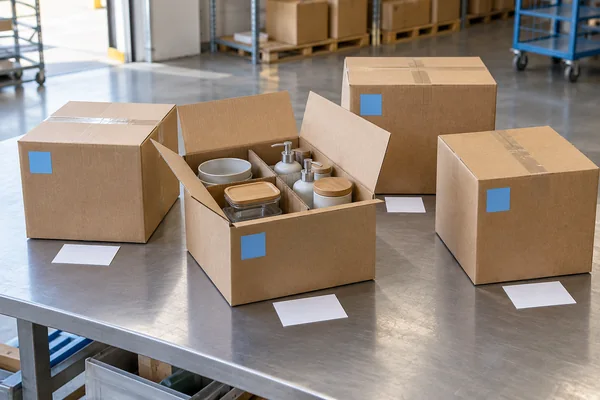
The order says what the buyer approved
Use the latest agreed order revision, including quantity by SKU, color, size, material and pack configuration. Include approved substitutions, split deliveries and changes. Check later messages too: the buyer may have approved a change after the original listing was saved.
The dispatch record says what the supplier reports sending
Request the packing list, carton marks, tracking numbers and dispatch dates. One order may travel under several tracking numbers, while one parcel may contain several order lines. Ask the supplier to explain that relationship rather than assuming one tracking number equals one complete order.
The receipt says what the warehouse actually checked
Ask whether the record covers outer cartons, opened cartons, sampled units or a complete item count. Record unchecked quantities as unchecked. If the warehouse photographed three closed boxes, the contents are still unverified.
GS1’s Receiving Advice guidance distinguishes goods received and accepted from quantities ordered or dispatched, with reporting possible by item and shipping container. For a small order, a worksheet can record those distinctions; electronic messaging is optional. The guidance is a reference for recordkeeping, not a claim that Dawon1688 uses GS1 identifiers.
Resolve the difference before cartons are mixed
1. Hold only the stock that needs a decision
Tell the warehouse which order lines or cartons must stay out of repacking and dispatch. Give the hold a clear reference and a named decision-maker. If unaffected goods can be separated reliably, the buyer can consider releasing those independently. Do not assume a warehouse will hold an entire shipment indefinitely without storage or handling charges.
Keep original carton labels and the link between each carton and its contents. Photograph the label, carton condition and relevant items before repacking. Agree on any opening, recounting or additional inspection work and its cost first.
2. Reconcile the unit of measure
Confirm whether the order uses pieces, pairs, sets, inner packs or cartons. A set may contain several components, and a carton may contain mixed variants. Write the conversion beside the count: for example, one set contains one main unit and two specified accessories. Confirm completeness against that definition rather than treating three components as three finished sets.
Do not convert carton counts to unit counts unless the packing quantity has been verified. A supplier’s expected case pack is not evidence that every carton contains that amount.
3. Request a focused recount

Identify the exact discrepancy: order reference, SKU, expected quantity, recorded quantity and cartons involved. Ask the warehouse to check the affected stock against the same version of the order. If labels are unclear, provide an approved product image and distinguishing features.
When the difference could be elsewhere in the shipment, expand the check to the relevant cartons. Counting a sample can reveal a problem but cannot establish an exact shortage across unchecked stock. Quantity checking also does not replace the product tests covered in a bulk-order inspection plan.
4. Ask the supplier a specific question

Send the discrepancy record and supporting photographs. Ask whether the remaining quantity was dispatched separately, omitted, substituted or packed under another reference. Request the evidence relevant to that answer: another tracking number, revised packing list or item-to-carton mapping.
If the supplier replies “everything was sent,” ask which carton contains the disputed SKU. Keep that explanation beside the warehouse count until the two can be reconciled. Neither message alone establishes responsibility.
5. Record a decision for each affected line
Possible decisions include waiting for an identified outstanding delivery, requesting replacement goods, returning the wrong item, accepting a documented substitution or shipping a reduced quantity. Availability, fees, timing and commercial remedies depend on the order and service agreements. Obtain the buyer’s approval rather than silently replacing one variant with another.
Ask promptly about applicable supplier, platform and carrier reporting requirements. This guide does not set a universal claim deadline or promise a refund.
6. Close the receipt and rebuild the outbound list

When replacement goods arrive, link their receipt to the original discrepancy instead of overwriting the original count. Record what happened to rejected or extra stock. Then create the export packing list from the goods approved for that dispatch, not from the original purchase quantity.
The U.S. International Trade Administration’s packing-list explanation identifies item quantities, package counts, marks and weights as shipment details and explains that a packing list does not replace a commercial invoice. Confirm the required documents for the actual route with the responsible shipping provider or customs professional.
Example: a correct total with the wrong variant mix
The following is a hypothetical example, not a Dawon1688 customer order. Assume a complete count has been performed and all quantities are individual pieces.
| Order line | Ordered | Supplier reports dispatched | Physically received | Accepted for this dispatch | Open issue |
|---|---|---|---|---|---|
| Blue pouch | 120 | 120 | 110 | 110 | 10 blue pieces outstanding |
| Black pouch | 80 | 80 | 90 | 80 | 10 extra black pieces held |
| Total | 200 | 200 | 200 | 190 | Variant mix remains unresolved |
Here, 200 pieces arrived, but only 190 match the approved order. Ten extra black pouches do not cancel a shortage of ten blue ones. If the buyer accepts the substitution, record the revised mix and any commercial adjustment. Otherwise, keep the extra pieces separate while the blue shortage is resolved.
Here, “accepted” means approved for this dispatch under the agreed check scope. It does not establish that every unit passed a functional or compliance test.
For a working ledger, add supplier and order references, SKU description, unit of measure, carton IDs, tracking numbers, checked quantity, evidence links, issue owner, agreed action and closure evidence. Keep an outstanding-delivery status separate from a confirmed shortage: the former may still be in transit.
Should you wait, replace, return or ship partially?
| Option | When to consider it | Confirm before approval |
|---|---|---|
| Wait for the balance | The supplier can identify a separate delivery | Tracking, expected arrival, storage cost and booking impact |
| Request replacements | The required SKU is missing or incorrect | Correct specification, dispatch evidence and another receipt check |
| Return affected goods | The buyer rejects the wrong or excess stock | Supplier acceptance, return address, charges and return record |
| Accept a substitution | The alternative is commercially and technically acceptable | Buyer approval, revised order and any labeling or document changes |
| Ship the accepted portion | Urgent stock can move without the unresolved lines | Separate packing list, extra logistics costs and plan for remaining goods |
Compare the actual costs and deadlines. Splitting a shipment can avoid waiting, but creates another dispatch to manage. The 1688 shipping guide covers the wider route and quotation decisions.
What to confirm with Dawon1688
Dawon1688’s service description includes supplier communication, receiving, basic warehouse checks and inspection coordination according to the agreed order scope. Before requesting a check, send the order revision, SKU list, tracking numbers and discrepancy evidence through the contact page.
Ask which cartons will be opened, whether the work is a sample check or complete count, what records will be supplied, and how held goods, returns or replacement deliveries will be handled. Confirm the charges and who approves each next step. Supplier remedies depend on the agreement and evidence; product performance and compliance need separate checks.
Frequently asked questions
1. Does a delivered tracking status prove that my whole 1688 order arrived?
No. It may record a parcel handover, while the order contains several parcels or different items inside one carton. Match all tracking numbers to the order and obtain the warehouse’s count scope before treating the order as complete.
2. What should I do if the carton count is correct but units are missing?
Check the agreed units per carton and whether any cartons contain mixed SKUs or partial packs. Request a recount of the affected contents, retain the carton references and record unchecked stock separately. Do not infer a full unit count from the number of outer cartons.
3. Can extra units of one color offset missing units of another?
Only if the buyer approves that substitution. Record the required and received quantities separately for each variant. Update the order, commercial agreement and outbound documents if the alternative mix is accepted.
4. Is a warehouse receiving check the same as a full quality inspection?
No. Receiving work may cover carton identity, quantity and visible condition within an agreed scope. Product performance, detailed defect checks or regulatory testing require their own methods and acceptance criteria. Confirm what is included before the check begins.
5. Should the warehouse repack the goods while a discrepancy is unresolved?
Keep affected goods and their original identification separate until the evidence and next action are recorded. Repacking can make it harder to trace contents back to a supplier carton. Unaffected stock may proceed if it can be identified and the buyer approves its release.
6. Can I ship the accepted goods while waiting for replacements?
Sometimes. Confirm that the accepted goods can be separated, obtain the revised packing list and compare the extra handling and freight costs. Keep the outstanding quantity open and specify who will approve and check the replacement delivery.
7. Who pays for recounting, returns or replacement shipping?
The answer depends on the supplier, warehouse and transport agreements and the established facts. Request written confirmation of the proposed remedy and each charge before proceeding. A discrepancy report does not by itself establish liability or a refund entitlement.
8. What evidence should close a receiving discrepancy?
Keep the original order and receipt, the verified difference, the buyer’s approved action and proof that it was completed. That may include a replacement receipt, return record or accepted order revision. The final packing list should show only the goods approved for the specific dispatch.