
Shipment consolidation means collecting orders from multiple suppliers at one warehouse, checking and repacking them, and sending them as one international shipment. For small businesses buying mixed products in modest quantities, consolidation can reduce repeated freight and handling costs, improve quality control before export, and make the shipment easier to manage.
However, consolidation is not automatically cheaper in every case. The result depends on the shipment’s weight and volume, warehouse and repacking fees, supplier delivery dates, destination, product restrictions, and chosen shipping method.
Shipment consolidation at a glance
- Best suited to: buyers ordering small quantities from several suppliers in the same country.
- Main benefit: fewer separate international shipments and better use of cargo space.
- Quality advantage: products can be checked before they leave the origin country.
- Possible trade-off: the whole shipment may wait for the last supplier to deliver.
- Important: restricted, hazardous, fragile, or incompatible goods may need separate handling.

What is shipment consolidation?
DHL defines consolidated shipping as combining multiple smaller shipments into one larger shipment. In a typical 1688 sourcing workflow, products from different Chinese suppliers are first delivered domestically to a consolidation warehouse. The warehouse records the cartons, checks the goods according to the buyer’s instructions, removes unnecessary packaging where appropriate, and prepares one export shipment.
Consolidation can be used with express delivery, air freight, rail freight, sea freight, or less-than-container-load shipping. The best method depends on the chargeable weight, cargo type, destination, budget, and required delivery time.
Why small businesses benefit more from consolidated shipping
Small businesses often test several products at once instead of placing one large order for a single SKU. That purchasing pattern creates multiple small supplier deliveries. If each parcel is shipped internationally on its own, the buyer may pay repeated pickup, minimum freight, documentation, clearance, and last-mile charges.
1. Lower fixed logistics costs
Many shipping costs are applied per parcel or per shipment, not only per kilogram. Combining several small consignments can reduce the number of minimum charges and administrative fees. It may also let the buyer choose a more economical freight method that would not make sense for each small order individually.
Savings are route-specific, so compare a complete consolidated quote with the total cost of separate shipping. Include domestic delivery, receiving, storage, inspection, repacking, export handling, international freight, customs clearance, duties, taxes, and final delivery.
2. Better control of dimensional weight
Large supplier cartons sometimes contain empty space or excessive protective material. Carriers may charge according to actual weight or dimensional weight, whichever is higher. UPS explains dimensional weight as a weight equivalent based on the space a shipment occupies.
When products are suitable for repacking, a consolidation warehouse can remove avoidable outer packaging and arrange the goods more efficiently. This may lower chargeable volume, although fragile products still require adequate protection.
3. Quality issues can be found before export
Returning a defective product is usually easier while the goods are still in China. At the warehouse, the buyer can request checks for quantity, color, model, visible damage, packaging, labels, or basic function. If a mismatch is found, the sourcing agent can contact the supplier before international shipping begins.

4. One coordinated shipment is easier to manage
Instead of tracking several international parcels with different arrival dates, the buyer receives one consolidated packing list and one coordinated shipment. Customs documentation can list multiple products and tariff classifications within the same consignment. This reduces operational fragmentation, but it does not remove the importer’s compliance obligations.
For example, U.S. Customs and Border Protection states that the importer remains responsible for meeting import requirements even when a customs broker is used. Requirements differ by country, so buyers should confirm product classification, valuation, labeling, licenses, and certifications before dispatch.
Separate shipping vs. shipment consolidation
| Factor | Separate international shipments | One consolidated shipment |
|---|---|---|
| Freight charges | Minimum and handling charges may repeat | Charges are concentrated into one larger shipment |
| Quality control | Depends on each supplier | Centralized inspection can be arranged |
| Packaging | Supplier packaging remains unchanged | Suitable goods can be repacked to reduce unused space |
| Tracking | Multiple tracking numbers and arrival dates | One coordinated international shipment |
| Customs work | Separate clearances may be required | Often one coordinated clearance with multiple line items |
| Speed | Ready orders can leave immediately | Shipment may wait for the last supplier |
| Risk concentration | One delayed parcel affects only that parcel | A delay can affect the entire consolidated load |
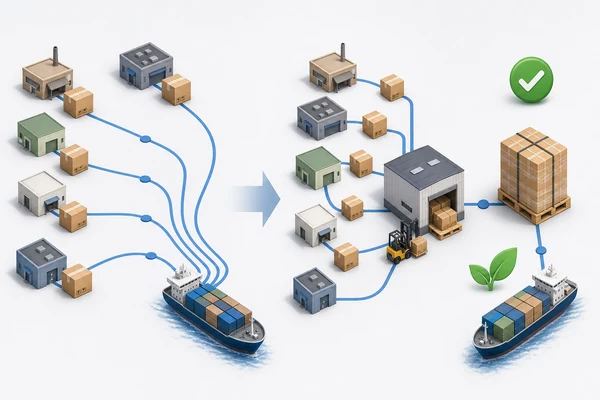
How shipment consolidation works
- Plan the order. Share product links, quantities, destination, delivery deadline, and any special handling requirements with the buying agent or consolidator.
- Send each order to one warehouse. Every supplier uses the warehouse address and the buyer’s unique identification mark or order number.
- Receive and record the cartons. Warehouse staff match incoming parcels to the supplier and purchase order, then record quantity, weight, dimensions, and visible condition.
- Inspect the products. Checks may include appearance, quantity, color, size, model, packaging, labels, and basic function, depending on the agreed inspection scope.
- Resolve discrepancies. Missing, incorrect, or defective goods can be reported to the supplier before export. Do not authorize consolidation until important issues are resolved.
- Repack and consolidate. Compatible products are packed into fewer export cartons or secured on a pallet. Unnecessary space may be removed without compromising protection.
- Prepare shipping documents. The shipment normally needs an accurate commercial invoice and packing list. Product-specific certificates or permits may also be required.
- Select the shipping method. Compare express, air, rail, and sea options using total landed cost and delivery time, not freight price alone.
How to calculate whether consolidation will save money
Estimated consolidation savings = total cost of separate international shipments – total cost of the consolidated shipment
The consolidated total should include:
- domestic delivery from each supplier to the warehouse;
- receiving, storage, inspection, labeling, and repacking fees;
- export handling and international freight;
- insurance, customs clearance, duties, and taxes; and
- delivery from the destination port or airport to the final address.
Illustrative example
Suppose three separate international shipments cost $120, $95, and $110, for a total of $325. A consolidated quote is $205 for freight plus $30 for receiving, inspection, and repacking, for a total of $235. The illustrative saving is $90, or about 28%.
This is not a guaranteed rate. Actual savings can be higher, lower, or zero depending on cargo density, route, timing, fees, and product restrictions. Ask for both scenarios using the same delivery terms before deciding.
When consolidation may not be the right choice
Consolidation is less suitable when:
- one urgent order cannot wait for other suppliers;
- products have different final destinations;
- batteries, liquids, powders, magnets, chemicals, food, cosmetics, or other restricted goods require different transport channels;
- fragile, oversized, high-value, temperature-sensitive, or hazardous products need specialized handling;
- supplier delays would create expensive warehouse storage; or
- combining the goods makes documentation, tariff classification, certification, or import licensing more complex.
In these cases, split shipping or partial consolidation may provide a better balance between cost and delivery time.
Shipment consolidation checklist
Before approving the shipment, confirm:
- every supplier order has arrived and has been matched correctly;
- quantities, models, colors, sizes, and visible condition have been checked;
- inspection photos or videos have been reviewed;
- defects and shortages have been resolved;
- restricted products have been declared to the forwarder;
- cartons are strong enough for the chosen transport method;
- the final carton count, gross weight, dimensions, and chargeable weight are recorded;
- the commercial invoice and packing list are accurate;
- product labels, country-of-origin marks, and destination requirements are met;
- insurance terms and claim procedures are understood; and
- the quote clearly states what is included and excluded.
How Dawon1688 supports consolidated orders
Dawon1688 can receive purchases from multiple 1688 suppliers at one warehouse, communicate with suppliers, inspect goods according to an agreed scope, consolidate compatible products, apply labels or custom packaging, prepare an invoice and packing list, and arrange international shipping.
Service requirements and costs vary by order. Review the current Dawon1688 pricing and request a written quote based on the products, carton data, destination, and deadline. If you are still choosing products or suppliers, see our guide to finding products on 1688.
Contact Dawon1688 with your 1688 product links, quantities, destination country, and preferred delivery date to receive a consolidation and shipping plan.
Frequently asked questions
Is shipment consolidation the same as freight forwarding?
No. Shipment consolidation is the process of combining smaller orders into one larger consignment. A freight forwarder may provide consolidation as part of a broader service that also includes booking transport, documentation, customs coordination, and delivery.
Can products from different 1688 suppliers be consolidated?
Yes. Each supplier can send its order to the same warehouse in China. The warehouse identifies the parcels, checks them against the purchase records, and combines compatible goods after all required orders arrive.
Does consolidation always reduce shipping costs?
No. It often reduces repeated minimum charges and unused packaging volume, but storage, inspection, repacking, special handling, or a supplier delay can offset the saving. Compare complete quotes for separate and consolidated shipping.
How long does shipment consolidation take?
Warehouse processing may be quick once all goods have arrived, but the overall timeline is usually determined by the slowest supplier, inspection findings, repacking needs, and shipping schedule. Ask each supplier for a realistic dispatch date before placing the orders.
Can batteries or other restricted products be consolidated?
Sometimes, but only when the carrier and route accept them and the required documents are available. Do not mix restricted goods with general cargo without written approval from the logistics provider.
Can a consolidated shipment contain multiple product types?
Yes, provided the products are compatible and properly declared. The commercial invoice and packing list should describe each item accurately, and customs entries may require separate tariff classifications and values for different products.
Is shipment consolidation suitable for Amazon FBA inventory?
It can be. The warehouse must follow Amazon’s current carton, product-label, shipment-label, and routing requirements. Confirm the destination fulfillment center and final delivery arrangement before the goods leave China.
What information is needed for a consolidation quote?
Provide product descriptions or links, quantities, estimated carton dimensions and weight, cargo restrictions, destination postal code or port, delivery deadline, inspection and repacking needs, and preferred Incoterms if known.
Last reviewed: July 21, 2026.