
Yes. 1688.com itself is legitimate: Alibaba Group describes it as China’s leading integrated domestic wholesale marketplace. The harder question is whether a particular seller and order are safe. Before paying, match the business identity to the receiving account, put the specification in writing, choose a traceable payment route, and decide how the goods will be checked and shipped.
Key takeaways
- 1688 is a legitimate platform. A seller still needs to be checked for the product and order in front of you.
- Store badges and transaction data help with screening, but neither proves that a supplier can meet a custom specification.
- Write down the material, dimensions, function, packaging, tolerances, and inspection criteria before comparing quotations.
- Keep the order and payment trail intact. Moving a transaction outside the agreed process may leave fewer usable records if something goes wrong.
- Compare landed cost, including China freight, service work, inspection, international transport, duties, and local taxes.
Is 1688.com a legitimate website?
Yes. Alibaba Group lists 1688.com as China’s leading integrated domestic wholesale marketplace and a strategic business of the group. Founded in 1999, it mainly serves China’s domestic market. The current corporate description is available on the Alibaba Group 1688 business page.
That answers the website question, not the order question. Listings can omit important details, suppliers have different capabilities, and a real order can still fail over specifications, quality, payment, compliance, or shipping.
For a broader introduction to the platform, read What Is 1688.com?. This guide focuses specifically on transaction risk and supplier verification.
What does “safe” mean when buying from 1688?
Most sourcing losses start in one of four places: the supplier identity, the product specification, the payment record, or the delivery plan. Check all four. A reassuring store page cannot compensate for vague product terms or an unexplained receiving account.
| Risk layer | Main question | Practical control |
|---|---|---|
| Supplier identity | Who is legally receiving the order and payment? | Match the store, business registration, quotation, invoice, and receiving account. |
| Product conformity | Will the goods match the buyer’s actual requirements? | Use a written specification, approved sample, photos, testing requirements, and inspection criteria. |
| Payment and records | Can the buyer prove what was ordered, agreed, and paid? | Keep quotations, chat records, purchase terms, account details, receipts, and change approvals. |
| Delivery and compliance | Can the goods be exported, imported, and delivered legally? | Confirm packaging, labels, documents, shipping method, product restrictions, duties, and destination rules. |
How to verify a 1688 supplier before placing an order
Supplier verification should end with a practical conclusion: can this named business supply this defined product under terms you understand and can document? Start with identity, then ask for evidence tied to the actual order.
1. Confirm the supplier’s legal business identity
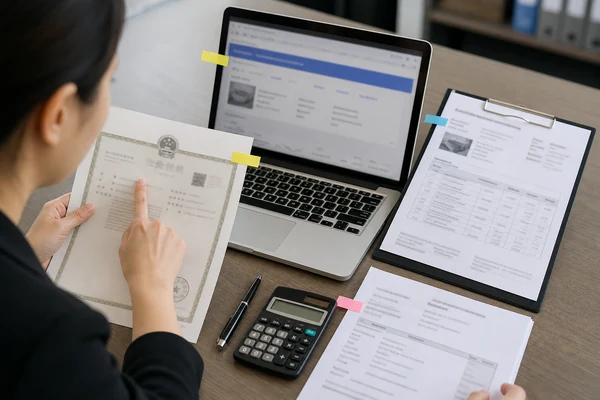
Write down the Chinese legal name shown in the store information. Compare it with the quotation, invoice, contract, and payment instructions, then check the registered business scope and operating status where reliable records are available.
If the names do not match, ask why. Suppliers sometimes use an affiliated company or an authorized payment arrangement, but the relationship should be documented before funds move. An unexplained change is a reason to stop.
2. Determine whether the seller is a manufacturer, trader, or distributor
Some 1688 sellers manufacture goods; others trade or distribute them. Look at the product range, registered scope, facility evidence, equipment, staffing information, and the quality of technical answers. A trading company may be the better fit for a mixed order, but you should know who controls production and where the margin sits.
A store full of unrelated products often points to trading or catalogue resale. A focused range does not prove factory ownership, though it does make product knowledge easier to test.
3. Review store history and transaction signals in context
Use operating history, transactions, repeat purchases, reviews, response quality, and dispute signals as context, not as a score. High sales say little about a new custom specification. A newer store may still be capable.
The useful test is consistency. Company history, product focus, pricing, transaction activity, and communication should tell roughly the same story. Large contradictions need an explanation.
4. Test the supplier’s product knowledge
Ask questions that cannot be answered by copying the listing: available materials, tolerance limits, component brands, production steps, test methods, carton dimensions, common defects, and what the quoted lead time assumes. A capable contact should be able to relate the answer to your specification.
For regulated or safety-sensitive goods, request the exact report or certificate. Check the model, standard, applicant, laboratory, and validity period. A document image is only useful when it can be tied to the product being ordered.
5. Use a controlled sample process
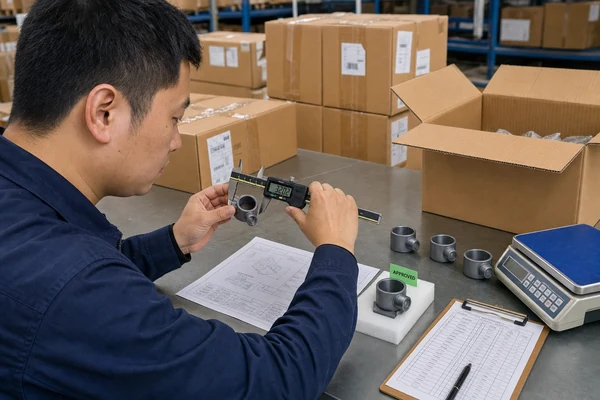
Use a sample to check appearance, dimensions, basic function, packaging, and the supplier’s attention to detail. Keep the approved sample or a signed specification as the production reference. Also ask whether the sample came from normal production or was prepared separately.
A good sample proves only that one acceptable unit exists. For a valuable, customized, safety-sensitive, or time-critical order, set the bulk inspection plan before production finishes.
6. Create a written purchase specification
A product link and a chat thread are rarely enough for a complex order. Prepare a written record covering:
- product name, model, material, colour, dimensions, weight, and function;
- approved components, acceptable alternatives, and prohibited substitutions;
- logo files, printing method, placement, packaging, barcode, and label requirements;
- quantity, unit price, sample status, lead time, and China delivery address;
- quality standard, inspection method, defect classification, and acceptance threshold;
- required reports, certificates, manuals, warnings, and shipping documents;
- responsibility for rework, replacement, delay, or non-conforming goods.
Write more detail where a mistake would be expensive or difficult to correct.
7. Verify payment instructions before sending funds

Confirm the receiving party’s legal name, account details, amount, currency, order reference, and exactly what the payment covers. Recheck a last-minute account change through a contact method you already trust. A fresh message with new bank or wallet details is not enough.
WorldFirst says Cross-border Pay 1688 was developed with 1688.com for international purchasing and lets eligible overseas buyers pay participating suppliers in RMB. Access, requirements, fees, and protection vary, so check the current Cross-border Pay 1688 information for your country and account.
8. Plan inspection and shipping before the balance payment
Set the inspection point, scope, evidence, and response to failure before the balance is due. The work may be as simple as warehouse photos and a quantity count, or it may require pre-shipment inspection and laboratory testing. Order value, product complexity, supplier history, and failure cost determine the sensible level.
Confirm where the supplier’s delivery responsibility ends. International buyers often need a China warehouse, consolidation, repacking, export coordination, and international transport. Our shipment consolidation guide covers the process for combining domestic orders.
Common warning signs when dealing with a 1688 supplier
One odd detail may have an innocent explanation. Several odd details that all make the transaction harder to verify are different. Slow down when you see the following:
Unexplained identity or payment changes
- The company name on the store differs from the quotation and receiving account.
- Payment instructions change shortly before the deadline.
- The supplier asks for payment to an unrelated personal account without a documented reason.
- The contact refuses to provide company details that should be available for a business transaction.
A price that cannot support the stated specification
An unusually low quotation may exclude packaging, accessories, tax, testing, domestic freight, or the requested material. It may also use a lower specification than the buyer expects. Ask the supplier to break down exactly what is included and compare like for like.
Pressure to skip samples or written confirmation
Urgency is sometimes genuine, but pressure becomes risky when it prevents basic checks. Be cautious if a supplier demands immediate full payment while avoiding a clear specification, sample approval, production schedule, or written response to quality questions.
Documents that do not match the product
A test report or certificate may refer to a different company, model, material, or standard. Check the details rather than relying on the presence of a logo or document cover page.
Communication that changes after the deposit
Repeated delays, unexplained substitutions, new MOQ demands, or refusal to provide production evidence after payment can indicate an order-control problem. Keep a written timeline and escalate questions early.
Is it safer to pay on-platform, pay a supplier directly, or use an agent?
No payment route suits every buyer. Choose one that is actually available to you, identifies the receiving party, leaves a usable record, and matches the purchasing agreement.
| Route | Potential advantage | Main control needed |
|---|---|---|
| Supported 1688 payment route | Order and payment records may remain connected within the purchasing flow. | Confirm eligibility, supplier participation, current terms, fees, and dispute conditions. |
| Direct payment to supplier | Can be practical for an established commercial relationship. | Verify company and account ownership, contract terms, payment milestones, and evidence retention. |
| Payment through a buying agent | The agent can combine payment assistance with communication, receiving, inspection, and consolidation. | Verify the agent, fee structure, exchange method, order records, service scope, and responsibility boundaries. |
Do not assume that a familiar payment method automatically provides protection for a commercial sourcing order. Confirm the actual transaction terms and available remedy before paying.
When can an international buyer purchase directly, and when is an agent useful?
Direct purchasing works best when the buyer can communicate with suppliers, pay through an available route, receive goods in China, define quality requirements, and manage export shipping. An agent becomes useful when several of those jobs need local coordination.
| Buying situation | Direct purchasing may work when… | An agent may add value when… |
|---|---|---|
| Simple stock product | The specification is standard and the buyer can pay and ship reliably. | The supplier does not support overseas communication, payment, or delivery. |
| Customized product | The buyer can manage drawings, samples, production changes, and inspection in Chinese. | Specifications, packaging, quality checks, and supplier follow-up need local coordination. |
| Orders from several suppliers | Each supplier can ship separately at an acceptable total cost. | Goods need to be received, counted, repacked, and consolidated at one China warehouse. |
| First order or high-risk product | The buyer has independent verification, inspection, compliance, and logistics resources. | The cost of a mistake justifies additional local checks and documented coordination. |
If you are comparing both approaches, review buying from 1688 without an agent and the current Dawon1688 service fee information. Base the decision on the work required and the total landed cost. The service fee is one line item.
1688 pre-payment safety checklist
Before approving a deposit or full payment, confirm that you can answer “yes” to the checks that apply to your order:
- Do I know the Chinese legal name of the business responsible for the order?
- Do the store, quotation, invoice, contract, and receiving account form a clear identity chain?
- Have I confirmed whether the seller is acting as a manufacturer, trader, or distributor?
- Is the product specification detailed enough to inspect objectively?
- Have materials, components, packaging, labels, and acceptable substitutions been confirmed?
- Do I understand the MOQ, unit price, tooling, sample, tax, and China domestic freight charges?
- Is the production lead time tied to a clear starting event, such as deposit and sample approval?
- Have required certificates or reports been matched to the exact company and product model?
- Is the payment route traceable and consistent with the agreed transaction structure?
- Has any changed payment instruction been reverified independently?
- Is there an agreed inspection or evidence plan before final shipment?
- Have international shipping, destination compliance, duties, and import restrictions been considered?
Final verdict: Is buying from 1688.com safe?
1688.com is legitimate. The safety of an order comes down to the supplier, specification, payment trail, quality control, and delivery plan. Verify each one before committing funds.
Badges, agents, payment services, and inspections all have limits. Use them as parts of a documented process. If you need local help with supplier information, order coordination, receiving, or consolidation, send the product link and requirements through the Dawon1688 contact page.
Frequently asked questions
Does a 1688 seller badge prove that the supplier is trustworthy?
No. Treat a badge as one screening signal. Check the legal identity, business scope, product capability, transaction pattern, quotation, and payment details as well. A valuable or highly customized order calls for stronger independent evidence.
What documents should I request before paying a 1688 supplier?
For most orders, request a quotation or pro forma invoice, a written product specification, company and payment details, a production schedule, packaging requirements, and any relevant test reports or certificates. Company names, product models, amounts, and dates should agree across the documents.
How can I confirm that a 1688 store and receiving account belong to the same business?
Compare the Chinese legal name in the store information with the quotation, invoice, contract, and receiving account. If the names differ, ask for a written explanation and evidence of the relationship. Recheck changed account details through a contact channel you already trust.
Is a factory video call enough to verify a 1688 supplier?
No. A live call can show facilities, products, staff, and current activity. It cannot establish ownership, legal identity, production capacity, or future quality on its own. Check the company, ask technical questions, approve a sample, record the terms, and inspect when the order risk warrants it.
What should I do if a supplier asks me to move the order or payment off-platform?
Pause the order. Ask why the change is needed, who will receive the money, which records will remain, and what dispute route applies. Verify the receiving entity and revised terms independently. A private transfer may leave you with fewer records than the original purchasing route.
Can an unusually low 1688 quotation be a warning sign?
Yes. A much lower price may exclude packaging, accessories, tax, testing, domestic freight, or the material you requested. Ask the supplier to itemize the quotation, then compare the same specification, quantity, quality standard, and delivery terms.
Which details should be written into the purchase order before production?
Record the product specification, materials, dimensions, colours, functions, components, quantity, price, packaging, labels, approved sample, lead time, inspection standard, required documents, delivery address, payment milestones, and the agreed response to defects, substitutions, or delay. If a requirement is vague, it will be hard to inspect later.