
1688 Agent vs Trading Company, when sourcing products from China, international buyers often face a key decision: should they work with a 1688 purchasing agent or a trading company? While both can help you source products from China, they serve fundamentally different roles in the supply chain. Understanding this difference is crucial for maximizing your profit margins and minimizing risks.
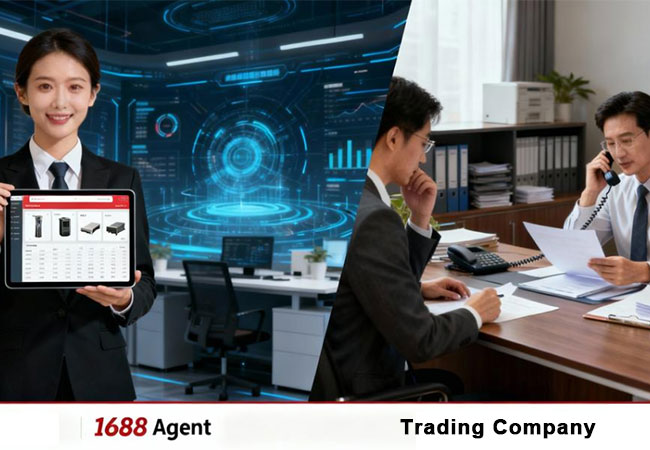
What is a 1688 Purchasing Agent?
A 1688 purchasing agent is your procurement representative who carries out purchasing tasks on your behalf. The core value proposition is service, not product markup.
A purchasing agent typically provides:
- Product sourcing: Searches 1688.com for products matching your requirements
- Supplier verification: Vets manufacturers for quality and reliability
- Price negotiation: Negotiates directly with factories for the best prices
- Quality inspection: Inspects products before shipment
- Consolidation: Combines orders from multiple suppliers into one shipment
- International shipping: Arranges freight forwarding and customs clearance
- Payment processing: Handles RMB payments to suppliers
The agent charges a service fee (typically 5-10% of order value) and passes through the factory price transparently. You see exactly what the factory charges.
What is a Trading Company?
A trading company is your supplier who sells products to you at a markup. The core value proposition is product transaction, not service.
A trading company typically:
- Purchases products from factories and resells them at a profit
- Adds 15-40% markup to the factory price
- May not disclose the original factory or true cost
- Handles export documentation and shipping
- May offer limited quality control
- Often presents itself as a manufacturer when it’s not
Key Differences at a Glance
- Role: Agent = your representative; Trading company = your supplier
- Pricing: Agent = factory price + service fee; Trading company = marked-up price
- Transparency: Agent = full cost transparency; Trading company = hidden markup
- Product access: Agent = any product on 1688.com; Trading company = limited to their inventory
- Flexibility: Agent = can switch suppliers freely; Trading company = locked to their supply chain
- Cost: Agent = lower total cost; Trading company = higher total cost
Price Comparison Example
Consider a product with a factory price of $10 per unit:
- Through a 1688 agent: $10 (factory) + $1 (10% service fee) = $11 per unit
- Through a trading company: $10 (factory) + $3 (30% markup) = $13 per unit
- Difference: $2 per unit, or 18% savings with an agent
For a 1,000-unit order, that’s a $2,000 savings — significant for any business.
When to Choose a 1688 Agent
A 1688 purchasing agent is the better choice when:
- You want maximum cost savings and price transparency
- You need to source multiple product types from different suppliers
- You want direct access to factory relationships
- You need quality inspection and consolidation services
- You’re comfortable with a service-fee model
- You want to import from China and build a business
When a Trading Company Might Make Sense
A trading company may be preferable when:
- You need a single point of contact for simplified ordering
- You’re buying small quantities that don’t justify agent fees
- You need ready-to-ship inventory without lead time
- You prefer a simple purchase transaction over a service relationship
How to Tell the Difference
Many trading companies present themselves as agents or manufacturers. Here’s how to identify which you’re dealing with:
- Ask for the factory name and address: Agents will share it; trading companies may not
- Request the factory invoice: Agents show it; trading companies won’t
- Check pricing consistency: Agents quote factory price + fee; trading companies quote a single price
- Ask about other suppliers: Agents can source from any factory; trading companies push their own products
- Look at their business scope: Check their business license — trading companies list “trade” as their scope
Why Dawon1688 is a Purchasing Agent, Not a Trading Company
Dawon1688 operates as a pure purchasing agent:
- Full price transparency — you see factory prices and our service fee
- Access to any supplier on 1688.com
- No inventory — we source fresh from factories for each order
- Quality inspection included in our service
- Consolidation and international shipping handled in-house
This means you get factory-direct pricing with professional service support, maximizing your margins and minimizing your risks.
Related Articles
- How to Import from China and Start a Business?
- Advantages of Buying on 1688
- What is 1688.com?
- Why Do Others Have Such Low Prices?
Frequently Asked Questions
What exactly does a 1688 purchasing agent do?
A 1688 purchasing agent acts as your representative in China, handling product search, supplier communication, order placement, payment through Chinese methods, quality inspection, domestic shipping consolidation, international freight forwarding, and sometimes customs clearance. They charge a service fee (typically 3-10% of order value) and provide the local presence and language skills that foreign buyers need to navigate 1688.com effectively.
How is a purchasing agent different from a trading company in China?
A purchasing agent works on your behalf for a transparent service fee and does not mark up product prices, while a trading company buys products from factories and resells them to you at a markup (often 10-30%). Agents give you access to factory-direct pricing and full supplier transparency, while trading companies offer convenience but hide the actual factory and add hidden margins.
Which is cheaper: using a 1688 agent or working with a trading company?
A 1688 purchasing agent is typically cheaper because they charge a transparent service fee (3-10%) on top of factory-direct prices, while trading companies embed hidden markups (10-30%) into product prices. For the same product, an agent’s total cost is usually lower, especially for larger orders where the agent’s percentage fee has less impact on per-unit cost.
What services does a 1688 purchasing agent provide that a trading company does not?
Agents provide supplier transparency (you know which factory produces your products), factory-direct pricing without hidden margins, customizable quality inspection protocols, consolidation of orders from multiple suppliers, and representation of your interests rather than their own profit margin. Trading companies control the supply chain and may switch suppliers without your knowledge.
How do I choose between a sourcing agent and a trading company for my business?
Choose a sourcing agent if you want cost transparency, direct factory access, quality control oversight, and long-term supplier relationships. Choose a trading company if you prefer a simple one-stop purchasing experience, don’t need to know the factory, and are willing to pay higher prices for convenience. For serious importers, agents offer better long-term value.
Can a 1688 purchasing agent help with quality inspection and shipping?
Yes, quality inspection and shipping management are core agent services. Agents can visit factories to conduct pre-production, in-line, and pre-shipment inspections with photos and reports. They also consolidate orders from multiple 1688 suppliers at their warehouse, arrange international shipping through preferred freight forwarders, and handle export documentation, providing end-to-end logistics support.
What are the risks of using a purchasing agent versus a trading company?
Agent risks include potential conflicts of interest (some agents receive kickbacks from suppliers), variable service quality, and reliance on the agent’s honesty. Trading company risks include hidden price markups, supplier opacity, and lack of quality control transparency. Mitigate risks by choosing agents with verified references, transparent fee structures, and clear contractual agreements.