To combine products from different Chinese suppliers into one retail kit, define the contents of one finished set before placing component orders. Give each component an exact specification and quantity, appoint a party to receive and pack the goods, approve one complete kit, and reconcile finished kits with the loose components left over. Confirm the packing work and checks in writing: putting several suppliers’ cartons into one shipment does not make their contents a ready-to-sell set.
Retail kitting in China can suit a buyer sourcing a pouch, notebook and pencils from different suppliers for one stationery set. Technical assembly, special storage and regulated handling need a separate scope. The process below is for packing approved, finished goods into physical retail sets. It does not establish marketplace eligibility.
Start with the finished kit, not the supplier orders
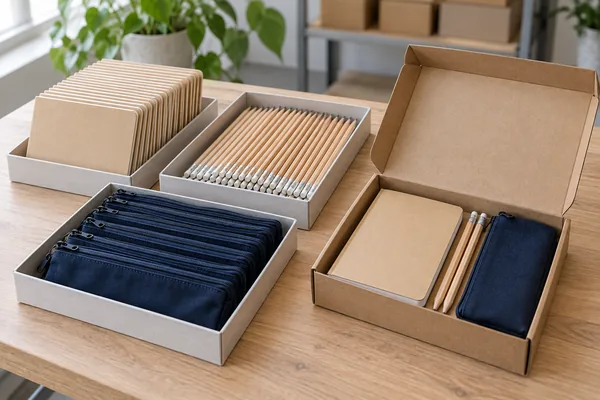
DHL describes kitting as grouping items into one ready-to-ship unit. Start with what the customer is buying. A transport carton containing unrelated orders is a consolidated shipment. A retail kit has a defined combination of products that must be complete each time it is sold.
Give that combination its own internal kit reference and revision. Then write a component list that someone who did not negotiate the order can follow.
| Field | What to specify | Why it matters |
|---|---|---|
| Finished kit | Internal SKU, revision and intended contents | Separates the retail set from its individual products |
| Component identity | Supplier, order reference, component SKU, variant and approved specification | Prevents a similar-looking item from being substituted |
| Quantity per kit | Pieces, pairs or other explicit unit of measure | Two pencils means two individual pencils, not two packs |
| Packaging | Box or pouch, insert, protection and closure | Defines the materials consumed for every completed kit |
| Printed material | Approved label and instruction-sheet versions, if needed | Keeps obsolete artwork out of a new kit revision |
| Build quantity | Target completed kits and treatment of remaining stock | Avoids confusing components received with kits ready to ship |
For a hypothetical stationery kit, “one notebook, two pencils and one pouch” is still incomplete if the notebook size, pencil variant or pouch color is unspecified. Link each line to the agreed purchase specification. Use a photograph to show placement alongside the component list.
Calculate how many complete kits the stock can support
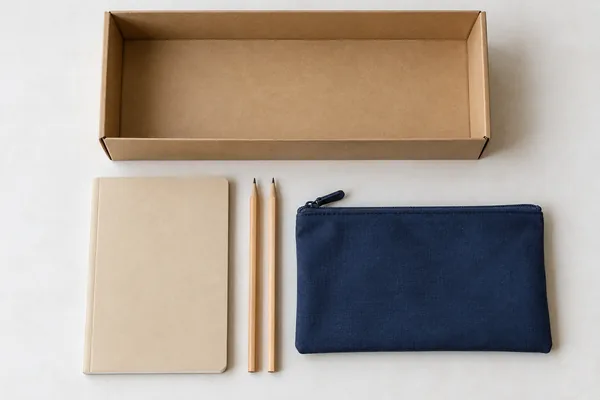
The limiting component determines the maximum number of complete kits. For each component, divide the usable quantity available by the quantity required per kit, round down, and take the smallest result. Include required packaging in that calculation.
Consider this hypothetical example, not a Dawon1688 customer order. Assume all listed goods have been accepted for the agreed use, and sufficient approved packaging is available.
| Component | Usable pieces available | Pieces per kit | Complete kits supported |
|---|---|---|---|
| Pouch | 100 | 1 | 100 |
| Notebook | 100 | 1 | 100 |
| Pencil | 195 | 2 | 97 |
The order can produce at most 97 complete kits, leaving three pouches, three notebooks and one pencil. It cannot produce 100 complete kits merely because the two larger items arrived in quantities of 100.
Do not include held, damaged, unidentified or unapproved stock in the usable quantity. If the buyer wants a reserve for packing losses or later replacements, specify it separately. There is no universal spare percentage that fits every product. Record any reserve used during packing.
If received quantities do not match the order, resolve that through the warehouse discrepancy process before releasing the affected goods for packing.
Decide where the kits will be packed
A supplier, an agreed service provider in China, or a destination warehouse may be suitable. Compare the complete work scope rather than a packing price alone.
| Packing location | When it may fit | What the buyer must confirm |
|---|---|---|
| One product supplier | That supplier agrees to receive the other components and pack the complete kit | Responsibility for third-party goods, storage, checks, shortages and leftover stock |
| A separate provider in China | Several suppliers deliver to a common receiving point | Whether the provider accepts this specific packing operation, its instructions, costs and release records |
| At destination | The kit mix is still changing or local packing offers better control | Separate component freight, storage, local labor and when the final set can be checked |
Do not assume that a shipping consolidator also offers retail packing. Inserting a leaflet is different from electrical assembly, filling containers or altering a product. Describe the actual work and obtain acceptance before sending goods.
Keep the two decisions separate: the shipment consolidation guide covers bringing orders together for transport; the custom packaging guide covers who supplies packaging and how that handoff is managed. Use a separate kit build record to track the finished selling units.
Issue one versioned packing instruction
The packing instruction should identify the kit revision, component quantities, placement, protection, labels and closure. Include photographs of the intended arrangement and the finished exterior. State what the packer should do when a component is missing, damaged or different: set the incomplete kit aside and request a decision, rather than substituting a nearby item.
Approve one complete trial kit
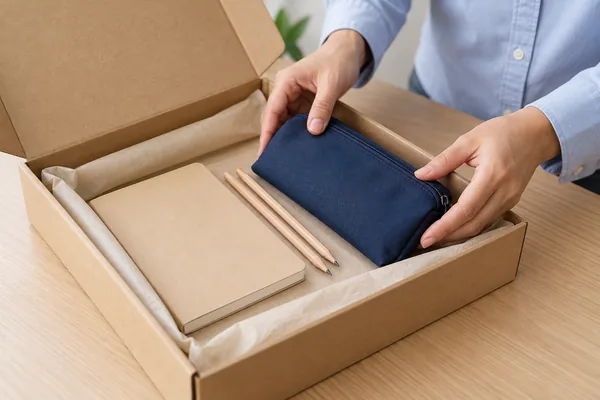
Use the intended components and packaging to make a complete trial kit. Check the contents against the list, the way the items fit, the position of any instructions and the finished label. Confirm that closing the package does not bend, press or rub the products. Record the accepted revision before the remaining kits are packed.
Approval of the individual products is useful, but it does not show that they fit together in the planned package. The existing sample approval checklist covers the wider product-standard decision; the kit trial checks the combined configuration.
Control changes after approval
If a component changes, identify the affected kit revision and review what else changes with it. A larger notebook could require a new insert; a different pouch color could change the customer-facing description. Separate old and new components until the buyer approves their use. Do not allow a mixed revision to become the default simply because both versions are on the packing table.
Reconcile components, finished kits and leftovers
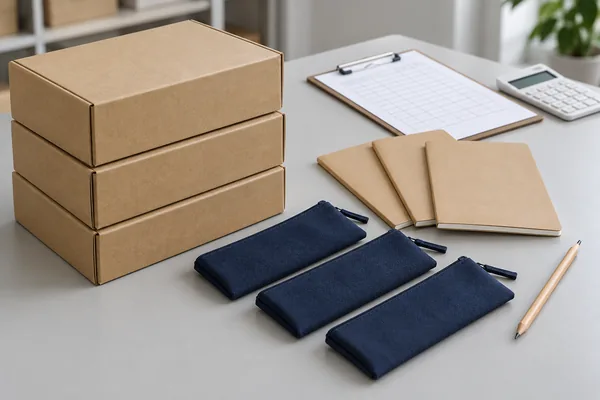
Ask for a build record with the completion photographs. It should show which components were issued, how many complete kits were accepted, what remains loose, and what is held or awaiting rework.
For each component, a basic reconciliation is:
Quantity issued = quantity in accepted complete kits + quantity in incomplete kits or rework + loose quantity returned + quantity rejected, lost or otherwise documented.
Use mutually exclusive categories so each component is counted once. Date the record and state the cutoff if packing is still in progress.
For the hypothetical 97-kit example, 194 pencils are inside finished kits and one remains loose. Recording all 195 pencils as available stock while also recording 97 complete kits would count the same goods twice.
Zoho’s composite-item documentation illustrates the underlying inventory treatment: building a bundle increases bundle stock while reducing its component stock. A small buyer can apply the same distinction in a worksheet; this is not a claim that Dawon1688 uses that software.
Keep incomplete kits out of the ready-to-ship total. Where goods are repacked or dismantled for rework, record the movement back to component stock and check the usable quantity again. Decide whether remaining components will be stored, shipped separately, returned or disposed of, and obtain approval for any related charges or disposal.
Check the finished set before releasing it
Check the finished configuration after packing, even when the incoming components have already been checked. A box can contain the right number of objects and still have the wrong combination.
The agreed check plan should address:
- Correct component identities and quantities in a kit.
- Correct kit revision and approved printed materials.
- Packing arrangement, product condition and closure.
- Label identity and barcode readability where applicable.
- Accepted finished-kit count, carton contents and remaining component stock.
Agree whether contents will be checked in every kit or under a defined sampling plan, who performs the work, and what happens when a defect is found. Sampled checks do not prove that every sealed kit is complete. Counting sets also does not replace functional or compliance checks on the products. Use the bulk-order inspection guide for the broader inspection agreement.
Separate the internal kit SKU from a retail barcode
An internal SKU helps identify your kit in order and stock records. It is not automatically a valid retail GTIN, and a component’s barcode does not necessarily identify the complete bundle.
GS1’s bundle guidance distinguishes a newly created physical bundle from a manufacturer-defined bundle and a virtual bundle. Confirm the applicable identifier with GS1 and the intended trading partner before printing labels. Do not assume that all sales channels accept the same bundle or label arrangement.
The buyer should also confirm permission to sell the selected products together and any applicable product, labeling or market requirements. Packing several compliant-looking items together is not itself evidence that the resulting retail offer meets those requirements.
What to send Dawon1688 for a scope check
Dawon1688’s service description covers sourcing and purchasing coordination, receiving goods from multiple suppliers, and order-specific checking, labeling and repacking work. That does not establish that every proposed kit or assembly operation is available.
Send the component list, supplier links or order references, target kit quantity, packing instruction, packaging specification, required checks and destination through the contact page. Ask Dawon1688 to confirm which tasks it can coordinate, who will perform them, the charges, and the records supplied on completion. Identify any technical assembly or special handling explicitly rather than treating it as ordinary repacking.
Before placing the bulk component orders, agree on the packing scope and how the complete trial kit will be approved.
Frequently asked questions
1. Is retail kitting the same as shipment consolidation?
No. Shipment consolidation combines goods for transport. Retail kitting combines specified products into a defined selling unit. A consolidated shipment may still contain loose items that need separate packing before sale.
2. Can I make one kit from products bought from several 1688 suppliers?
Yes, if the products, intended sales channel and packing requirements permit it, and a provider agrees to receive and pack them. Define the component identities, quantities and kit revision before ordering. Do not assume that any supplier or warehouse accepts this work automatically.
3. How do I calculate the number of complete kits I can make?
Divide each component’s usable available quantity by its required quantity per kit, round down, and use the smallest result. Include required packaging and exclude held or unapproved stock. The component with the lowest result limits the complete-kit quantity.
4. Should I approve the individual products or the complete kit?
Both serve a purpose. Individual product approval defines what each item should be. A complete trial kit checks the combined contents, fit, arrangement, printed materials and closure. Approve the final kit revision before bulk packing begins.
5. Can the packer replace a missing component with a similar item?
Not without the buyer’s approval. The replacement may change the fit, appearance, listing or requirements for the finished set. Hold the incomplete kits, document the proposed change and update the kit specification before using a substitute.
6. What should happen to components left over after packing?
Reconcile them against the build record and keep them separate from completed kits. Record quantities and condition, then agree whether they will be stored, shipped separately, returned or disposed of. Approve any associated charges and do not count components already inside kits as loose stock.
7. Does a retail kit need its own barcode?
It depends on the identifier system and the intended trading partner. An internal kit SKU is not the same as a GTIN. GS1 distinguishes physical bundles, manufacturer-defined bundles and virtual bundles, so confirm the correct identifier and sales-channel requirements before labels are printed.
8. Can Dawon1688 coordinate packing my retail kit?
Ask Dawon1688 to confirm the specific operation before committing the goods. Its sourcing and purchasing coordination includes order-specific services, not an automatic commitment to manufacture or assemble every proposed kit. Send the component list and packing instruction, and agree on the responsible party, charges and checks.