
For a sea-freight order from 1688, agree the moisture-protection plan before the supplier packs the goods. The brief should identify the moisture-sensitive materials, the proposed packaging, who checks packing conditions, and what evidence the buyer receives before release. A request to “add silica gel” leaves too many decisions unanswered.
This guide covers ordinary, non-dangerous consumer goods moving through China-side purchasing and consolidation. Food, medicines, temperature-controlled cargo and products with special technical requirements need their own qualified packaging and transport advice.
Start with the product and the journey
Identify the vulnerable parts with the supplier: the product, a metal fitting, a paper insert, the retail box, or several of them. Send the same brief to the packaging provider and freight coordinator. They need to know whether goods will wait at the factory, be opened for inspection, be repacked at a consolidation warehouse, or travel in a shared container.
The IMO/ILO/UNECE CTU Code is a non-mandatory global code of practice for packing cargo transport units. Its guidance covers the intermodal chain, not just the ocean crossing. That makes the handovers before loading relevant to a buyer’s packing instructions.
Prepare these details before asking for a protection proposal:
- Product materials and the condition that would make the goods unacceptable.
- Unit, retail-box and master-carton packaging, including any inner bags.
- Expected storage and transport stages, destination and known seasonal conditions.
- Whether cartons will be opened, inspected, combined or repacked.
- Who approves the proposed packaging and any additional cost.
If the order itself is not yet defined, settle the SKU, quantity and product specification first. A packaging proposal for one material or pack configuration should not silently carry over to another.
Distinguish moisture sources before choosing a remedy
Wet goods can result from external water exposure or condensation within the transport unit. Cargo, timber and porous packaging can introduce moisture; wrapping already damp materials can make the situation worse. See Annex 3 and Annex 7 of the complete CTU Code hosted by IPPC for the mechanisms and packing precautions.
| Question for the supplier | Useful evidence to request | Decision it supports |
|---|---|---|
| Were cartons or materials exposed to rain or wet storage? | Dated receiving and packing photographs, plus the affected carton or material IDs. | Whether the affected materials need assessment or replacement before packing. |
| Is a moisture-sensitive material being packed? | The material-specific acceptance requirement and agreed checking method. | Whether a specialist measurement or packaging review is needed. |
| Will packaging be opened after the supplier seals it? | The inspection and repacking sequence, with a named person responsible for resealing. | Where the approved protection must be restored. |
| Who controls final container loading? | Written confirmation from the consolidator or freight provider. | Which requirements the product supplier can actually carry out. |
Do not treat a photograph of a clean carton as a moisture measurement. Where a numerical limit matters, agree the material, instrument, method, locations and acceptance value with a qualified provider. A reading without that context is difficult to use.

Review the complete protection proposal
The packaging proposal should cover inner packaging, any barrier material, the closure, desiccant and handling instructions together. Have the provider explain the purpose of each element and the conditions assumed.
Container-level and individual-pack protection are different purchasing decisions. A container product is chosen for the shipping environment; an inner-pack system must suit the product and the sealed package. Ask the provider to explain the intended location rather than accepting “desiccant included” as a complete specification.
Clariant’s cargo-desiccant guidance states that quantities vary with shipping conditions and the nature of the goods. Its published configurations are product-specific. Do not copy a quantity into an unrelated order or treat every small sachet as interchangeable.
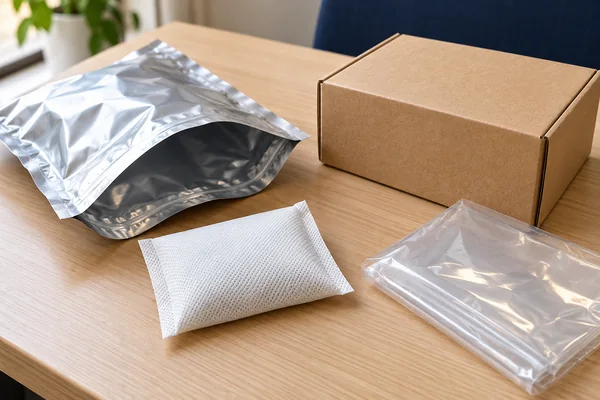
What to ask the packaging provider
- Which product and packaging configuration does the recommendation cover?
- What storage period and journey assumptions were used?
- What is the specified desiccant product, quantity and placement?
- How must it be stored before use, and when should it be installed?
- What closure or seal is required, and how will it be checked?
- What must happen if the package is opened for inspection?
Request the relevant product instructions and handling information. Confirm compatibility with the goods and packaging before approval. Neither an unlabelled packet nor a supplier’s statement that it is “export standard” is a sufficient specification.
Make consolidation and repacking part of the instructions
For example, in a hypothetical multi-supplier order, one factory prepares retail boxes while another sends loose units. The warehouse then changes the final pack. Give the coordinator the approved packaging revision and identify what may be opened or replaced.
Use a short handover record for each supplier lot: carton IDs, received condition, any packaging changes, the person doing the work and the final release decision. If goods arrive wet or packaging is damaged, separate the affected units from those ready to ship and request an assessment. Do not approve concealment of the issue inside a fresh outer carton.

Clarify control in a shared container
For less-than-container-load shipping, ask the freight provider which container-level precautions can be specified and documented. The product supplier may not select the final container or control neighboring cargo. Obtain a clear answer rather than assuming that a note on the purchase order reaches the final packer.
Our shipment-consolidation guide explains the broader receiving and shipping process. For moisture protection, also name the party responsible at each handover.
Agree evidence and release conditions before dispatch
Use the purchase brief to define a manageable evidence set. Ask for photographs of the agreed packing stages, identification of the packaging materials used, and records of any specified measurements. Link the evidence to the actual lot rather than an undated sample box.
If a humidity indicator or logger is proposed, agree its purpose, placement, reading procedure and the action required by the result. Do not let a single photograph substitute for a defined acceptance process. Record what was measured and when, so the buyer can interpret the result.
Write down who may release the goods when an exception occurs. For example, if packaging is changed after inspection, the buyer should know whether another check is required and who authorizes it. Agree this workflow with the supplier before adding it to the order.
Keep the scope within the agreed pre-shipment inspection. Where technical assessment is needed, arrange it explicitly. If damage has already occurred at destination, use the separate arrival-damage guide for evidence preservation and next steps.

Send Dawon1688 a moisture-protection brief
Dawon1688 coordinates supplier communication, packaging, inspections and shipment consolidation. Send your product links, materials, quantities, destination, planned shipping method and proposed protection requirements through the Dawon1688 contact page.
Ask which checks and packing steps can be coordinated for your order. Confirm specialist packaging advice, measurement equipment, inspection scope and fees separately. Coordination does not establish a guaranteed moisture-free shipment or replace a product-specific technical assessment.
Frequently asked questions
1. Is adding silica gel enough for a sea-freight order from 1688?
Not by itself. Ask the packaging provider to specify the complete arrangement, including the product, packaging, closure, desiccant and journey assumptions. The quantity and placement must suit that arrangement; a generic request for a few packets is incomplete.
2. Can a supplier use the same protection for every product?
Do not assume so. Identify the product materials, retail packaging, storage stages and shipping method. Ask the provider to confirm that the proposed protection covers that exact configuration and to review material or packaging changes.
3. Should I set one humidity limit for all my orders?
No universal value is offered here. If a numerical requirement matters, agree a product- or material-specific limit and measurement method with a qualified provider. Record where and when the check is made and what happens if the result is outside the agreed range.
4. What should I request if cartons look wet before shipment?
Identify and separate the affected cartons, record their condition and ask for an assessment before release. Confirm whether the product, inner packaging or outer carton is affected. Replacing the outer carton alone does not establish that the contents are acceptable.
5. Does a plastic liner solve condensation risk?
A liner should be part of a reviewed packaging arrangement, not an automatic fix. The CTU Code warns that wrapping can promote moisture damage when the overall moisture content is too high. Have the provider assess the initial condition and proposed closure before approval.
6. What changes when several suppliers’ goods are consolidated?
Record each lot’s received condition and preserve its approved packaging instructions. Assign responsibility for any opening, inspection, repacking and resealing. Confirm the container-level arrangements with the freight provider rather than assuming each product supplier controls them.
7. Can Dawon1688 coordinate moisture-protection requirements?
Dawon1688 offers supplier communication, packaging and inspection coordination, and consolidation support. Ask which steps can be arranged for the specific order. Specialist advice, instruments, testing, materials and fees require separate confirmation.
8. What should be approved before the order is released?
Approve the packaging revision, the completed checks and the disposition of any exceptions. Keep dated evidence tied to the shipment’s lots or carton IDs. Name the person authorized to release the goods and define when a packaging change requires another review.