Key takeaways
- Turn the supplier’s lead time into dated milestones with measurable outputs.
- Production photographs are useful only when they can be traced to your order, product revision, location, date, and quantity.
- Track schedule and product conformity separately. An order can be on time and still be wrong.
- Require written approval before a material, component, process, subcontractor, tooling location, or factory changes.
- Use a during-production inspection when there is enough work in progress to examine and still enough time to correct the process.
What should production monitoring prove?
Production monitoring should answer two questions: is the agreed order moving through the factory, and is the factory making it to the controlled specification? “60% complete” may mean that material has been cut, or that finished units exist but printing and packaging have not started. Ask what was counted and checked.
Keep four records distinct:
- Schedule status: which milestone has started, which has finished, and what is blocking the next one.
- Quantity status: units or components received, started, completed, rejected, reworked, packed, and still outstanding.
- Quality status: which material, dimension, function, appearance, branding, or packaging checks were performed and what the results were.
- Change status: every proposed or approved departure from the purchase order, sample, specification, process, or production site.
The deposit stage should already have established the legal parties, product revision, payment milestones, and production trigger. If those points are still open, return to the Chinese supplier deposit checklist.
Set the production baseline before the first status update
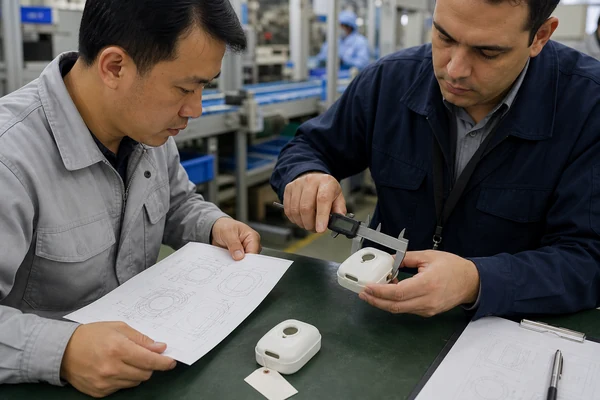
A monitoring plan cannot repair a missing specification. The factory, buyer, sourcing agent, and inspector need the same controlled reference before production begins.
The baseline should contain the purchase order, product specification, bill of materials when appropriate, drawing, approved sample ID, artwork, packaging files, test methods, defect criteria, quantity by SKU, and the agreed delivery point. Give every file a revision number or date. Mark obsolete versions so an old drawing cannot return to the production floor.
If the supplier received conditional sample approval, record the remaining corrections and how they will be verified. A correction may need a revised sample, first-off unit, factory measurement record, or on-site check. Dawon1688’s product sample approval checklist explains how to connect the approved reference to measurable production criteria.
Hold a short production kickoff in writing or by video call. Confirm the order number, factory, responsible contact, approved files, material plan, subcontracted steps, planned dates, inspection window, and update schedule. Send a written summary afterward.
Replace one lead time with production milestones
A quoted lead time is a forecast. Break it into the work that can be observed. The exact stages depend on the product, but each milestone should have a planned date, completion rule, responsible party, and evidence.
| Milestone | Evidence to request | Question the evidence should answer |
|---|---|---|
| Order release | Accepted purchase order, approved revisions, deposit receipt, and written production release | Has the factory received a complete and authorized order? |
| Material readiness | Material description, supplier or batch reference, quantity received, labels, and incoming-check results | Are the specified materials available and identified for this order? |
| First production output | First-off units, measurements, function results, finish or colour comparison, and correction record | Can the normal process reproduce the approved reference? |
| Work in progress | Started, completed, rejected, and reworked quantities by SKU; line photos or video; in-process QC records | Is output progressing at a credible rate without a growing defect problem? |
| Branding and packaging | Production print, label, barcode scan, packed unit, carton data, and artwork revision | Are the sellable unit and export packaging being made to the approved files? |
| Inspection readiness | Finished and packed quantity, location of the complete lot, packing list, and proposed inspection date | Will the inspector be able to examine the correct production lot? |
Ask the supplier to revise the dates when an actual event moves. Do not preserve an old shipping date by quietly removing the correction or inspection window. A useful schedule shows the current forecast and the reason for the change.
Request evidence that belongs to your order
Factory photos and videos are easy to misread. Ten good units do not show the production quantity, and a row of cartons does not prove what is inside. An undated video may show an earlier order.
Ask for a visible order reference in overview images where practical. Show enough of the workstation, material, product, or carton group to establish context. A useful video is one continuous walkthrough from the order identification to the work in progress, followed by the requested close-ups.
Match evidence to a question. For colour, show the approved reference and production unit under the same controlled lighting. For quantity, request SKU counts and wide views of identified groups. A dimension record should show the measuring point, instrument, permitted range, and actual reading.
Supplier-generated evidence remains a self-check. Use it for routine tracking. Arrange an on-site or suitably controlled remote inspection when the decision requires independent sample selection, factory access, repeatable testing, or a formal report.
Check materials and components before they disappear into the product
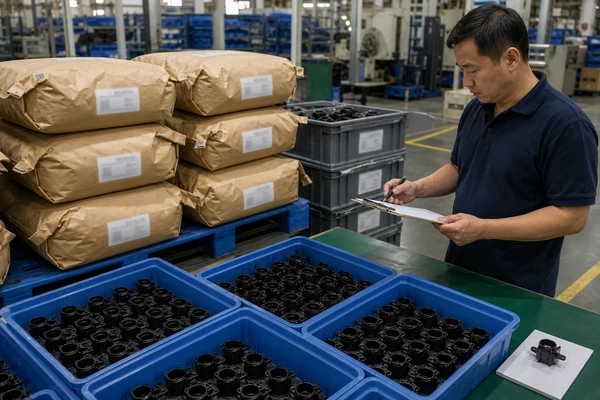
Many substitutions become difficult to identify after assembly, coating, sewing, filling, or packaging. Monitor the characteristics that affect function, compliance, durability, appearance, or cost while they are still visible.
For a moulded product, this may include resin grade, colour batch, insert material, and first-off dimensions. Textiles may require fabric specification, weight, colour lot, accessories, and print setup. Electronics can require component model, firmware version, battery cell, connector, and power supply identification. Let the product specification decide what matters.
Request incoming material records or traceable labels where the factory uses them. Critical or regulated characteristics may also need product-specific laboratory testing. A material-label photograph does not establish chemical composition, electrical safety, or food-contact suitability.
Change control also protects earlier test evidence. For U.S. general-use consumer products subject to CPSC certification rules, the U.S. Consumer Product Safety Commission’s material-change guidance says that a change to design, manufacturing process, or component source may require retesting when it could affect compliance. Requirements depend on the product and applicable rule, so review a proposed change with a qualified compliance professional.
Control factory, process, and subcontractor changes
Chinese suppliers may subcontract printing, plating, heat treatment, sewing, electronics assembly, packaging, or another specialist process. Subcontracting is not automatically a defect. An undisclosed change is a control problem when it affects the approved product, delivery plan, inspection access, or compliance evidence.
Require a written change request before the supplier changes:
- a material, component, formulation, finish, or colour source;
- a manufacturing, assembly, testing, or packaging process;
- the factory, subcontractor, tooling location, or production line;
- a drawing, tolerance, artwork file, label, barcode, or packout;
- the agreed quantity, price, completion date, or delivery point.
The request should describe the reason, affected quantity, proposed revision, effect on price and schedule, approval evidence, and treatment of units already made. Before approving it, check customer use, inspection criteria, packaging fit, and required testing.
For a custom or confidential design, limit which files each factory or subcontractor receives and keep a record of production locations. The guide to protecting your product design with a Chinese supplier covers controlled disclosure, tooling, surplus units, and production records.
When should you arrange a during-production inspection?
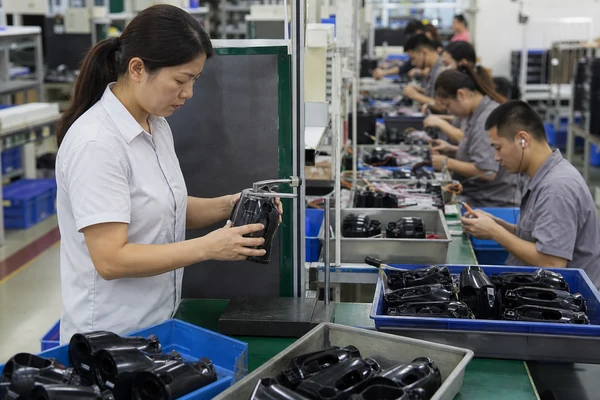
A during-production inspection, often called DPI or DUPRO, examines work in progress while manufacturing is active. It differs from a pre-shipment inspection of the finished lot. QIMA, for example, lists initial, during-production, pre-shipment, and loading checks as separate stages.
Choose the inspection date from the production process. The factory needs representative output for the planned checks, while enough production must remain for a correction to affect the rest of the order. Intertek’s DUPRO service normally inspects when 10-15% of the merchandise is completed. That is one provider’s model. A fast printing run, long curing process, or multi-stage assembly may need different timing.
A DUPRO is worth considering when:
- the order is large enough that late rework would be costly;
- the supplier or production process is new to the buyer;
- the product has critical material, workmanship, function, branding, or packaging requirements;
- the approved sample required several correction rounds;
- production evidence is inconsistent, delayed, or difficult to trace;
- a component, subcontractor, process, or factory has changed;
- the delivery date leaves little room for correction after final inspection.
Give the inspector the purchase order, approved specification, sample reference, artwork, quantity breakdown, process stage, test instructions, and known concerns. State whether the objective is to verify materials, first production output, line workmanship, production quantity, corrective action, or several of these.
Sampling needs a plan. ISO 2859-1:2026 defines AQL-indexed sampling schemes for lot-by-lot inspection by attributes and applies to products, components, materials, operations, and work in progress. The chosen approach must fit the available quantity, risk, test method, and decision. It cannot prove that every unit conforms.
Respond to a delay or production deviation with a written decision
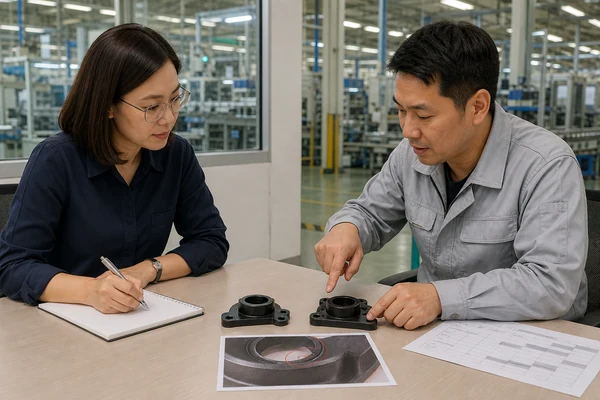
When a problem appears, first establish its scope. Identify the affected material, SKU, process, quantity, and production dates. Separate units already made from units that have not entered the problem step.
Ask the supplier for a corrective-action proposal that states:
- what happened and how the cause was identified;
- which units or materials may be affected;
- what will be stopped, sorted, reworked, replaced, or remade;
- how the correction and the remaining production will be verified;
- the revised dates for production, inspection, packing, and handover.
Pause the affected process when continued output would increase loss. Unaffected work can continue only when the factory keeps the materials, units, and records separate.
Verify the correction where it can be observed. One close-up does not show that all affected units were sorted. Use a controlled count, repeat measurement, targeted inspection, laboratory test, or reinspection as appropriate. Record an accepted deviation as a new revision.
Once the goods are complete, use the separate guide to inspect a bulk order before paying the balance. A during-production check can catch an early problem, but it does not replace inspection of the finished quantity and final packaging.
Use a short, repeatable production report
A useful update can fit on one page. Ask the supplier to use the same fields each time so you can compare the current report with the previous one.
| Report field | What to record |
|---|---|
| Order identity | Purchase order, SKU, product revision, factory, and report date |
| Current stage | Operation in progress, planned completion, actual completion, and next dependency |
| Quantities | Materials received, units started, finished, rejected, reworked, packed, and outstanding |
| Quality checks | Checks performed, sample size, actual results, defects found, and open corrective action |
| Changes | Requested, approved, rejected, and pending changes with revision references |
| Schedule | Current forecast for inspection, completion, packing, and delivery to the agreed point |
| Evidence | Order-specific photos, video, measurement sheets, material records, or inspection report |
Review exceptions instead of exchanging daily “on schedule” messages. A weekly report often works for a routine multi-week order. Use milestone updates during material arrival, first production output, a correction, or the final days before inspection. Short orders may be easier to track by event.
Production monitoring checklist
- Freeze the purchase order, specification, sample, artwork, packaging, tests, and defect criteria.
- Confirm the factory, responsible contacts, subcontracted work, and production release.
- Break the lead time into dated milestones with completion rules.
- Track quantities by SKU and production state, not only a percentage.
- Request traceable evidence for material readiness and first production output.
- Compare in-process units with the approved reference and actual tolerances.
- Record internal QC checks, defects, rework, and unresolved results.
- Require approval before any material, process, supplier, subcontractor, or site change.
- Arrange a targeted during-production inspection when early independent evidence can change the outcome.
- Update the inspection and delivery dates when a delay removes the correction window.
- Verify corrective action on the affected quantity, not only on a photographed unit.
- Keep the final pre-shipment inspection and balance-payment decision as separate control points.
How can a China sourcing agent help monitor production?
A sourcing agent can communicate with the supplier in Chinese, organize the production file, request milestone evidence, visit or contact the factory, record changes, and coordinate an independent inspector. The quotation should say which tasks are included. Routine supplier follow-up, a warehouse receiving check, an on-site production visit, and a formal third-party DUPRO are different services.
Dawon1688 can review an order that it is sourcing or coordinating in China and define a practical follow-up scope based on the product, factory location, production stage, and evidence required. Buyers can send the product specification, quantity, supplier details, approved sample status, destination country, and current production concern through the Dawon1688 contact page. Confirm the service scope, access, inspection criteria, fees, and reporting method before work begins.
Final answer
Monitor production against dated milestones, controlled specifications, quantities, quality results, and approved changes. Ask for evidence that can be traced to the order. Use a during-production inspection when independent checks can still prevent the same problem from spreading through the full run, then inspect the finished lot separately before the agreed balance or shipment release.
Frequently asked questions
1. How often should I ask a Chinese supplier for production updates?
Match the frequency to the production stages. A routine multi-week order may need a weekly report plus updates when materials arrive, first-off units are checked, packaging starts, and the lot becomes ready for inspection. Ask more often while a defect, material shortage, or delay is unresolved. Daily messages add little when the factory has no new milestone or evidence to report.
2. At what production stage should I arrange a DUPRO inspection?
Arrange it when representative work in progress and the materials or processes you need to check are available, but before the same step has been completed across the order. Some inspection providers use a percentage such as 10-15% complete, but that is not universal. Select the point based on the product workflow, affected SKUs, inspection scope, and time available for correction.
3. Can supplier photos prove that my full order is in production?
No. Photos can show the items visible in the frame. They do not establish the total quantity, date, location, ownership, or condition of units that were not shown. Ask for order identification, wide views, SKU counts, and a continuous video walkthrough where useful. Use independent inspection when the decision requires controlled access or sample selection.
4. How can I confirm that the factory is using the approved material?
Define the material precisely, then check purchase or incoming records, batch labels, supplier references, quantities, and factory test results where available. Compare the material with the bill of materials and approved sample. For composition, restricted substances, safety, or other regulated properties, arrange appropriate testing or review traceable technical documents; a label photograph alone is not enough.
5. What should I do if the supplier changes a subcontractor after production starts?
Pause the affected step until the supplier identifies the new subcontractor, reason for the change, affected process, units already made, and effect on quality, access, cost, testing, and schedule. Decide what evidence is needed before approval. This may include a new first-off sample, process record, on-site check, or targeted test. Record an accepted change as a controlled revision.
6. Is a during-production inspection worthwhile for a small order?
It depends on the possible loss rather than quantity alone. A small order with safety requirements, expensive tooling, a new supplier, tight launch date, or difficult-to-correct customization may justify an early inspection. For a low-value stock order from a known supplier, documented factory checks and a final inspection may be proportionate. Compare the inspection cost with the cost of late rework, replacement, and missed sales.
7. What should I do if production is late but the supplier still promises the original shipping date?
Ask for the completed quantity, remaining operations, daily output, material status, packing capacity, and revised dates for inspection and handover. Check whether the supplier plans to recover time by adding capacity, subcontracting, reducing tests, or compressing the correction window. Accept a revised schedule when necessary. Do not remove inspection or approve unreviewed changes simply to preserve the old shipping date.
Sources and further reading
- International Organization for Standardization: ISO 2859-1:2026 sampling procedures for inspection by attributes
- QIMA: product inspection stages, including initial, during-production, pre-shipment, and loading checks
- Intertek: During Production Inspection (DUPRO)
- U.S. Consumer Product Safety Commission: general-use product certification and material change guidance