Key takeaways
- Different prices often describe different products, quantities, packaging, or delivery responsibilities.
- Use one RFQ revision and one comparison sheet. A supplier’s unconfirmed assumption belongs in an open-issues column, not in the price.
- Keep unit cost, one-time project costs, China-side logistics, international freight, duties, and taxes on separate lines.
- Choose the quotation that fits the order after missing details are resolved, samples are checked, and the commercial terms are written into the purchase order.
Why can Chinese suppliers quote very different prices for the same product?
The product may look the same in a photograph while the quotations are based on different assumptions. One factory may use the specified material and include a retail box. Another may assume a cheaper grade, bulk packing, and a larger order. A third may separate the mould fee and quote delivery to a Shenzhen port instead of collection at its factory.
Put those differences in the comparison sheet before ranking the quotes. Each supplier should identify the product revision, material, quantity, packaging, testing scope, trade term, named place, and exclusions behind its price.
Supplier role can also affect a quote. A manufacturer, trading company, and sourcing company may include different work in their prices. That does not make one type automatically cheaper or better. Start by checking who will manufacture the goods, who will sign the order, and who will receive payment. The guide to finding the right customization supplier explains those checks in more detail.
Start with one controlled RFQ and product revision
A comparison breaks down when suppliers quote from different messages, drawings, or sample photos. Give every shortlisted supplier the same RFQ package and assign it a revision number. If you clarify a requirement, send the update to all suppliers still being compared and record which quotation replaces the earlier one.
The RFQ should state the planned quantity and price breaks, product specification, material or component requirements, packaging, destination country, testing needs, requested trade term, and timing. For a custom product, identify which details are fixed and where the supplier may propose an alternative.
Do not ask for a precise price while leaving the expensive parts open. A phrase such as “good quality material” gives the factory no measurable baseline. Name the resin grade, fabric composition, component model, coating requirement, tolerance, test method, or approved reference that controls cost. If the final choice is not known yet, ask suppliers to quote the same two defined options.
What should go into a supplier quotation comparison sheet?
Copy the information from emails, spreadsheets, PDFs, and chat messages into one table. Keep the supplier’s answer as written, then add a separate buyer note for assumptions or follow-up. A blank cell means “not confirmed.” It does not mean free, included, or acceptable.
| Comparison field | What to record | Why quotations become misleading |
|---|---|---|
| Legal seller | Chinese company name, business role, factory location, and payment recipient | The quotation may come from one company while another company manufactures or receives payment |
| Product basis | RFQ revision, drawing, sample, material, components, tolerances, colour, and finish | A lower price may use a different material or omit a difficult requirement |
| Quantity | Order quantity, MOQ basis, colour or size split, and price breaks | Suppliers may quote different volumes or set MOQ per variant |
| Unit price | Amount, currency, tax or invoice basis, and rounding rule | RMB and foreign-currency offers can use different exchange assumptions or domestic tax treatment |
| Packaging | Unit pack, inserts, labels, retail box, master carton, pallet, and artwork work | “Standard packaging” can mean different materials and carton quantities |
| One-time charges | Sample, mould, jig, setup, printing plate, artwork, testing, and file fees | One supplier may include a charge in the unit price while another lists it separately |
| Quality and compliance | Inspection scope, test reports, laboratory testing, certificates, and acceptance criteria | A document fee does not prove that the quoted product meets the destination requirement |
| Trade term | Incoterms rule, named place or port, year, and included local charges | EXW Shenzhen and FOB Shenzhen do not stop at the same delivery point |
| Lead time | Sample time, tooling time, production time, start trigger, and peak-season limits | “20 days” is unclear unless the start event and scope are stated |
| Payment | Deposit, balance trigger, method, account name, and refund or credit terms | The same total price can create very different cash exposure |
| Validity and exclusions | Expiry date, exchange or raw-material conditions, excluded work, and open questions | An offer can change before the buyer finishes sampling or packaging approval |
Compare the product before comparing the unit price

Start with the requirements that affect function, safety, appearance, or durability. The exact list depends on the product, but it may include material grade, thickness, component model, tolerances, coating, accessories, and testing. Keep every supplier alternative visible as a deviation until the buyer accepts it.
A quotation based on a reference photo is provisional. The price may change after the factory receives drawings, opens a sample, confirms the bill of materials, or tests a difficult process. That is not automatically a bait-and-switch. Ask the supplier to show what changed between revisions and which requirement caused the adjustment.
Use sample work to close technical gaps before treating a quotation as the production baseline. The product sample approval checklist explains how to connect the approved sample with drawings, measurements, packaging, and written acceptance records.
Separate recurring unit cost from one-time project costs
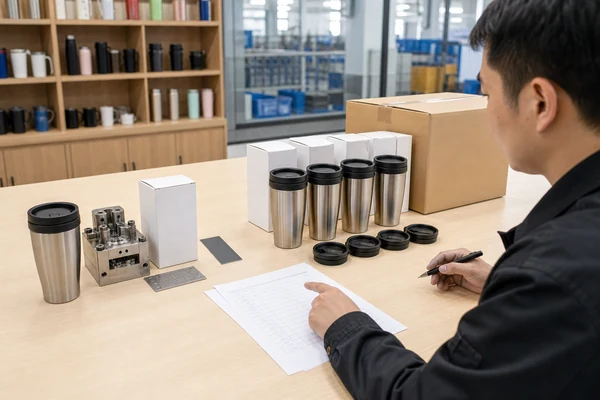
A low unit price can sit beside an expensive mould, sample programme, or custom packaging minimum. Keep those amounts separate so the buyer can see the first-order payment, the recurring cost, and any later credit.
For internal analysis, you can spread a reusable tool or setup charge across a planned volume. Keep the original charge visible. The first-order cash payment remains the same even if a spreadsheet spreads it across future units.
Record ownership beside every tooling or design charge. The quote should identify the mould, jig, printing plate, CAD work, packaging dieline, or artwork file covered by the payment and say whether the buyer can inspect, transfer, or receive it. Price comparison and ownership are separate questions.
How do you compare EXW, FCA, FOB, CIF, and DDP quotations?

Quotations using different Incoterms rules are not ready for a unit-price comparison. Convert them to one handover point or show the additional logistics lines separately.
The International Chamber of Commerce states that Incoterms 2020 rules allocate certain tasks, costs, and risks between seller and buyer. They do not set the product specification, payment terms, transfer of ownership, tariffs, or dispute law. The sales contract must cover those matters separately. See the ICC’s Incoterms 2020 questions and answers.
For EXW, ICC explains that delivery occurs when the seller places the goods at the buyer’s disposal at the named place. The seller does not have to load the collecting vehicle or clear the goods for export under the rule. ICC cautions that EXW gives the seller the fewest obligations and may create practical export-clearance problems for an overseas buyer. Its EXW explanatory notes suggest considering FCA when the seller should handle export clearance.
FOB applies to sea and inland waterway transport and uses a named port of loading. For container or multimodal movements, the ICC’s Incoterms checklist points buyers toward FCA rather than automatically using FOB. Ask the freight forwarder which handover point and rule fit the actual transport plan.
Write the rule, precise named place or port, and “Incoterms 2020” in the quotation. “FOB China” is not precise enough. Neither is “DDP your country” without a destination, importer arrangement, duty basis, and list of excluded charges.
Compare MOQ by total commitment, not by unit price alone
A supplier may offer a lower unit price only at three times the planned quantity. The extra inventory and cash tied up before the product is proven can make that offer a poor fit for the first order.
Compare each MOQ option using the same product and packaging basis. Record the total goods value, one-time charges, required deposit, expected stock cover, and any variant-specific minimum. If the supplier accepts a mixed colour or size order, confirm the split in writing.
For a first order, a higher unit price at a workable quantity can produce a lower cash commitment. That is a business choice, not a universal rule. The article on getting a lower MOQ for custom products covers material, packaging, process, and variant constraints.
How should payment terms, lead time, and quote validity affect the decision?
Two quotations with the same total can require very different cash commitments. A larger deposit moves more money before production evidence exists, while a balance due before inspection leaves less room to verify the finished lot. Compare both the amount and its payment trigger.
Lead time also needs a start point. Ask whether production begins after the deposit, approved sample, artwork approval, material arrival, or all of them. Separate tooling, sampling, production, packaging, and China-side delivery. A single lead-time number often hides whichever step has not started yet.
Record quotation validity and the conditions that can reopen the price. Currency, resin, metal, electronic components, packaging paper, or freight may change, but the supplier should explain when a revision applies. An expired quote is a signal to reconfirm; it is not proof that the new number is reasonable.
Do not treat compliance documents as a line-item shortcut
If a test report or certificate is included, check the issuing body, product model, applicable standard, report date, applicant, and tested configuration. A document for a similar model may provide background, but it does not automatically cover your order.
Keep compliance work separate from ordinary factory quality control. A pre-shipment inspection can compare the finished lot with approved requirements, but it does not decide whether the importer has met every legal obligation. For U.S. imports, for example, U.S. Customs and Border Protection states that the importer of record is responsible for using reasonable care with entry, classification, value, and applicable legal requirements. See CBP’s Importing into the United States. Buyers in other markets should check the rules that apply to their product and destination.
A practical method for normalizing supplier quotations

- Freeze the RFQ revision used for the comparison.
- Enter each supplier’s answer into the same table without filling gaps on the supplier’s behalf.
- Mark substitutions, exclusions, and unconfirmed assumptions.
- Ask focused follow-up questions and request a revised written quotation.
- Convert currencies using one recorded exchange-rate date for internal comparison.
- Calculate supplier-controlled cost to one handover point, then estimate international freight, duty, tax, and destination charges separately.
- Compare total cash required for the planned order, including the deposit and one-time costs.
- Check the sample, supplier identity, payment account, lead-time trigger, and quote validity before selection.
- Move the chosen quotation basis into the purchase order and production specification.
The landed-cost estimate will remain provisional until packaging dimensions, weight, classification, route, and destination charges are confirmed. Dawon1688’s first custom order budget guide explains how to keep goods, tooling, inspection, freight, duty, tax, and service fees on separate lines.
Which quotation warning signs deserve a follow-up?
- The price arrives before the supplier has reviewed the specification or required quantity.
- The material, component model, finish, packaging, or trade term is missing.
- The supplier changes a requirement without identifying it as a deviation.
- The quoted company, contracting company, store owner, and payment recipient do not match.
- The supplier refuses to separate one-time charges from the recurring price.
- The quote says “all included” but does not name the delivery point or exclusions.
- A large price reduction appears only after quality checks, testing, or inspection rights are removed.
These points call for evidence or clarification; they do not prove fraud. If the answer remains vague, leave the item open and keep the quotation out of the final price ranking.
Which Chinese supplier quotation should you choose?
Choose only after the offers describe the same requirement and delivery basis. The selected quotation should state what the supplier will make, what is included, what is excluded, when the price expires, and what evidence must exist before each payment.
The lowest comparable price can be a sensible choice when the supplier, sample, capacity, and terms are acceptable. A higher offer may fit better if it covers the required material, a workable MOQ, complete packaging, or delivery work omitted by the cheaper quote.
A weighted score can help a team discuss trade-offs. It should not average away a serious unresolved issue such as an unverified seller, missing specification, or unacceptable payment account.
Quotation checklist before paying a deposit
- Confirm the Chinese legal seller, production site, contracting party, and payment recipient.
- Attach the correct RFQ, drawing, specification, and quotation revisions.
- Resolve every product, material, component, colour, finish, and packaging deviation.
- Confirm quantity, MOQ basis, variant split, unit price, currency, and one-time charges.
- State the Incoterms rule, named place or port, year, and included local charges.
- Write the sample, tooling, production, packaging, inspection, and delivery schedule with start triggers.
- Confirm deposit, balance trigger, payment method, quotation validity, and price-revision conditions.
- Record testing, document, inspection, rework, and reinspection responsibilities.
- Transfer the accepted commercial basis into the purchase order instead of relying on chat history.
Before releasing the balance, compare the finished lot with the approved specification and sample. The guide to inspecting a bulk order before balance payment covers sampling, defect evidence, corrective action, and reinspection.
Final answer
Compare quotations only after they use the same product revision, quantity, packaging scope, currency, and delivery point. Keep missing information visible and one-time charges separate. Choose an offer whose assumptions can be written into the purchase order without guesswork.

Frequently asked questions
1. What should I do when one supplier quotes EXW and another quotes FOB?
Ask both suppliers or your freight forwarder to convert the offers to one agreed handover point. Record the exact named factory, terminal, or port and use the same Incoterms 2020 basis. Do not compare the two unit prices until loading, export clearance, origin transport, terminal, and port charges are assigned consistently.
2. How can I confirm whether packaging is included in the unit price?
Ask for a packaging breakdown that names the unit pack, inserts, labels, retail box, master carton, pallet, artwork work, and carton quantity. Request separate prices for optional packaging. Put the approved packaging specification and quotation revision into the purchase order.
3. Should I give every supplier a target price before requesting quotations?
A target can help when it is tied to a clear product and volume, but it can also anchor every reply to the same number. For an initial market check, ask several qualified suppliers to quote the same RFQ independently. Share a target later if you want them to propose a defined material, process, packaging, or MOQ change that reaches the budget.
4. Why did the supplier revise the quotation after making the sample?
Sampling may reveal a different material yield, longer cycle time, additional tooling, tighter tolerance, more manual work, or packaging that was not visible in the first RFQ. Ask for a written change log. A justified revision should identify the new requirement and cost driver rather than replace the old price without explanation.
5. How should I compare quotations with different deposit percentages?
Calculate the amount paid at each milestone, not just the percentages. Compare what evidence exists before the deposit, before production, before balance payment, and before shipment. A smaller deposit is not automatically safer if the remaining amount is due before the buyer can inspect the finished goods.
6. Does a longer quotation validity make an offer safer?
No. Validity tells you how long the supplier intends to hold the stated terms, subject to any written conditions. It does not prove that the specification is complete or that the supplier can perform. Check material assumptions, exchange-rate clauses, component availability, production capacity, and exclusions before relying on the expiry date.
7. What should I do when the cheapest quotation omits part of the specification?
Mark the quotation as incomplete and ask the supplier to confirm the missing requirement in writing. Do not insert an estimated allowance and treat the offer as accepted. If the supplier cannot meet the requirement, record the proposed alternative as a deviation and decide whether it is technically and commercially acceptable before comparing prices again.
Sources
- International Chamber of Commerce: Incoterms 2020 Questions and Answers
- International Chamber of Commerce: EXW Explanatory Notes
- International Chamber of Commerce: Incoterms 2020 Checklist and Flowcharts
- U.S. International Trade Administration: Know Your Incoterms
- U.S. Customs and Border Protection: Importing into the United States